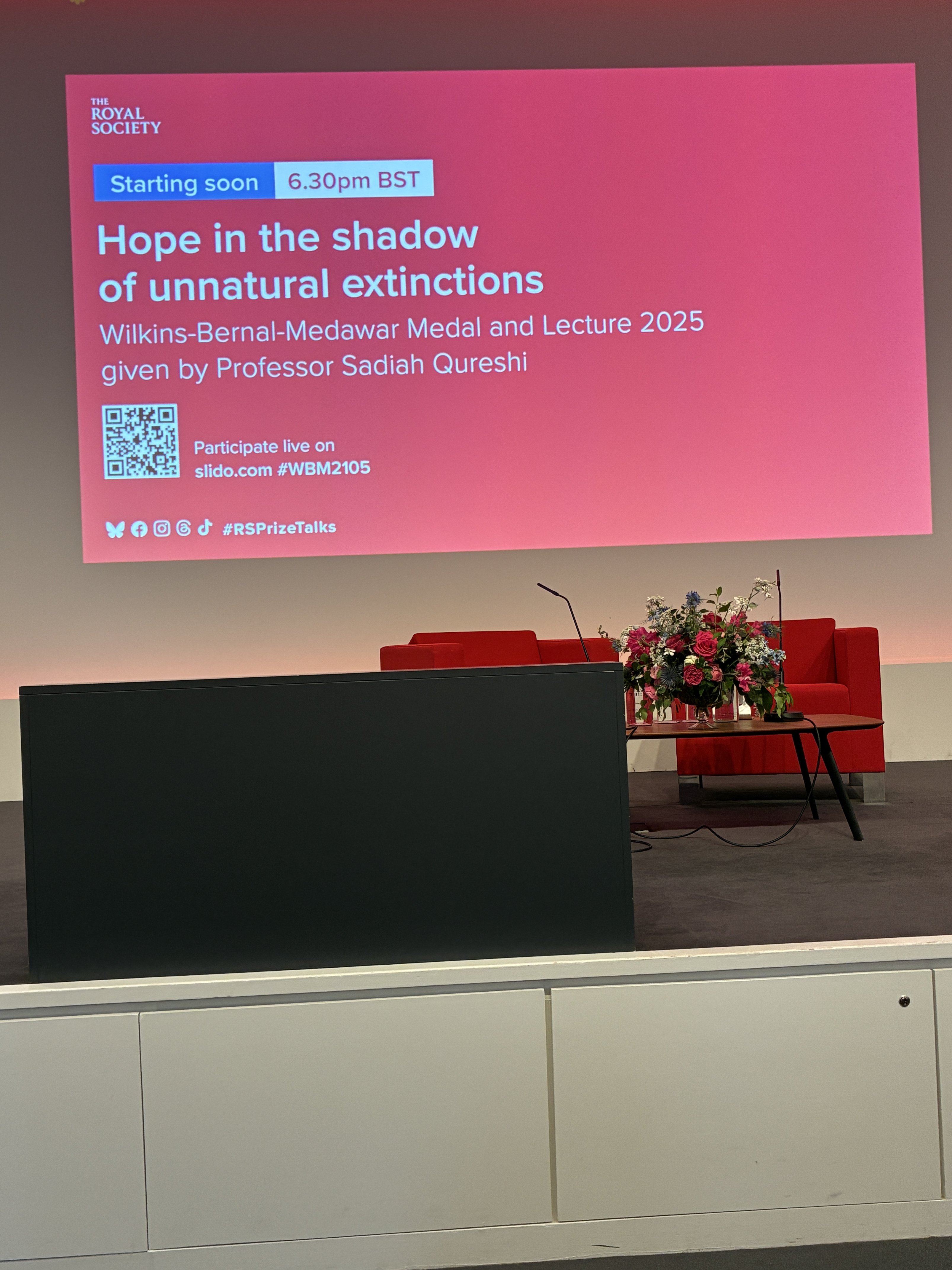
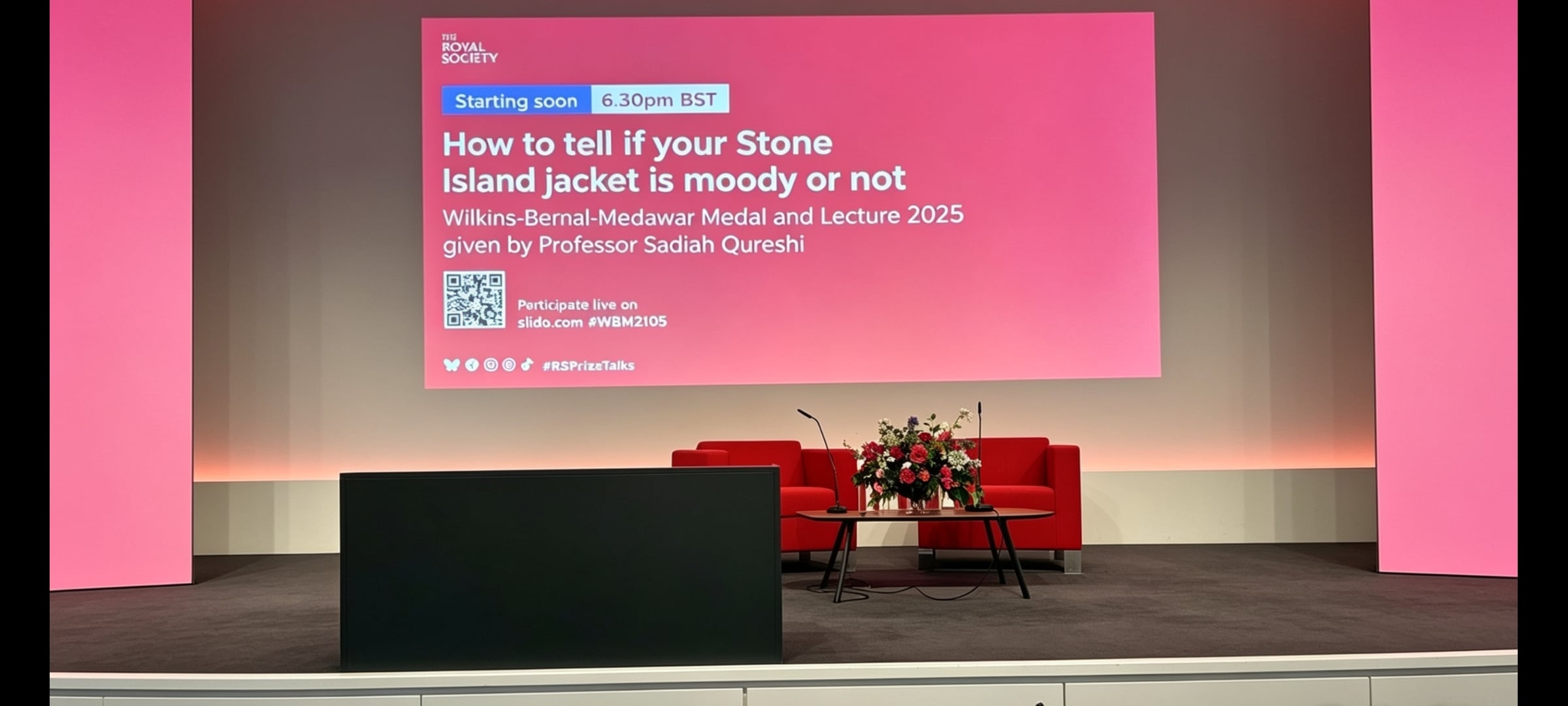
A bit of intellectualism this evening.

At least, I hope so. The title looked interesting and the ticket was free so I thought, why not?
Comments
-
Let us know if you bump into any Millwall fans there.AddicksAddict said:At least, I hope so. The title looked interesting and the ticket was free so I thought, why not?
12 -
Funnily enough…CaptainRobbo said:
Let us know if you bump into any Millwall fans there.AddicksAddict said:At least, I hope so. The title looked interesting and the ticket was free so I thought, why not?
3 -
You're going to tell us that Professor Sadiah Qureshi is a Spanner?AddicksAddict said:
Funnily enough…CaptainRobbo said:
Let us know if you bump into any Millwall fans there.AddicksAddict said:At least, I hope so. The title looked interesting and the ticket was free so I thought, why not?
2 -
She's laid on some jellied eels for after the lecture.EugenesAxe said:
You're going to tell us that Professor Sadiah Qureshi is a Spanner?AddicksAddict said:
Funnily enough…CaptainRobbo said:
Let us know if you bump into any Millwall fans there.AddicksAddict said:At least, I hope so. The title looked interesting and the ticket was free so I thought, why not?
7 -
And some cans of Stella?CaptainRobbo said:
She's laid on some jellied eels for after the lecture.EugenesAxe said:
You're going to tell us that Professor Sadiah Qureshi is a Spanner?AddicksAddict said:
Funnily enough…CaptainRobbo said:
Let us know if you bump into any Millwall fans there.AddicksAddict said:At least, I hope so. The title looked interesting and the ticket was free so I thought, why not?
1 -
I attended a similar lecture:
“Hope of progress in the shadow of morons”
It was about a football club who neighbours are knuckleheads and mouth breathers, yet struggled to find success.The answer was apparently to be found in SE70 -
This is the kind of thing that sets us apart.
Here a summary of Sadiah Qureshi's book, published last year:
Vanished: An Unnatural History of Extinction
Anyone alive today is among a tiny fraction of the once living: over 90% of species that ever existed are now extinct. How did we come to think of ourselves as survivors in a world where species can vanish forever, or as capable of pushing our planet to the verge of a sixth mass extinction?
Extinction, Sadiah Qureshi shows us, is a surprisingly modern concept – and a phenomenon that’s not as natural as we might think. In Europe until the late eighteenth century, species were considered perfect and unchanging creations of God. Then in the age of revolutions, scientists gathered enough fossil evidence to determine that mammoth bones, for example, were not just large elephants but a lost species that once roamed the Earth alongside ancient humans. Extinction went from being regarded as theologically dangerous to pervasive, and even inevitable.
Yet Vanished shows us that extinction is more than a scientific idea; it’s a political choice that has led to devasting consequences. Europeans and Americans quickly used the notion that extinction was a natural process to justify persecution and genocide, predicting that nations from Newfoundland’s Beothuk to Aboriginal Australians were doomed to die out from imperial expansion.
Exploring the tangled and unnatural histories of extinction and empire, Vanished weaves together pioneering original research and breath-taking storytelling to show us extinction is both an evolutionary process and a human act: one which illuminates our past, and may alter our future.
Let us know how it goes @AddicksAddict
I predict an evening which blurs science, politics and race.
Take that, Crystal Palace.3 -
I've got a spare ticket for her next talk if you wanna tag along?EugenesAxe said:
You're going to tell us that Professor Sadiah Qureshi is a Spanner?AddicksAddict said:
Funnily enough…CaptainRobbo said:
Let us know if you bump into any Millwall fans there.AddicksAddict said:At least, I hope so. The title looked interesting and the ticket was free so I thought, why not?
8 -
I would totally go to this.Dave Rudd said:This is the kind of thing that sets us apart.
Here a summary of Sadiah Qureshi's book, published last year:
Vanished: An Unnatural History of Extinction
Anyone alive today is among a tiny fraction of the once living: over 90% of species that ever existed are now extinct. How did we come to think of ourselves as survivors in a world where species can vanish forever, or as capable of pushing our planet to the verge of a sixth mass extinction?
Extinction, Sadiah Qureshi shows us, is a surprisingly modern concept – and a phenomenon that’s not as natural as we might think. In Europe until the late eighteenth century, species were considered perfect and unchanging creations of God. Then in the age of revolutions, scientists gathered enough fossil evidence to determine that mammoth bones, for example, were not just large elephants but a lost species that once roamed the Earth alongside ancient humans. Extinction went from being regarded as theologically dangerous to pervasive, and even inevitable.
Yet Vanished shows us that extinction is more than a scientific idea; it’s a political choice that has led to devasting consequences. Europeans and Americans quickly used the notion that extinction was a natural process to justify persecution and genocide, predicting that nations from Newfoundland’s Beothuk to Aboriginal Australians were doomed to die out from imperial expansion.
Exploring the tangled and unnatural histories of extinction and empire, Vanished weaves together pioneering original research and breath-taking storytelling to show us extinction is both an evolutionary process and a human act: one which illuminates our past, and may alter our future.
Let us know how it goes @AddicksAddict
I predict an evening which blurs science, politics and race.
Take that, Crystal Palace.2 -
Can I wear a string vest?CaptainRobbo said:
I've got a spare ticket for her next talk if you wanna tag along?EugenesAxe said:
You're going to tell us that Professor Sadiah Qureshi is a Spanner?AddicksAddict said:
Funnily enough…CaptainRobbo said:
Let us know if you bump into any Millwall fans there.AddicksAddict said:At least, I hope so. The title looked interesting and the ticket was free so I thought, why not?
1 -
Sponsored links:
-
the umble pie and mash shop now theres a fackin endangered species mate1
-
Good idea in this weather, might join you. 👍EugenesAxe said:
Can I wear a string vest?CaptainRobbo said:
I've got a spare ticket for her next talk if you wanna tag along?EugenesAxe said:
You're going to tell us that Professor Sadiah Qureshi is a Spanner?AddicksAddict said:
Funnily enough…CaptainRobbo said:
Let us know if you bump into any Millwall fans there.AddicksAddict said:At least, I hope so. The title looked interesting and the ticket was free so I thought, why not?
2 -
I wore shorts and an African top and it didn’t cause a problem. Just don’t go sporting a “Hunt the Whale” badge.EugenesAxe said:
Can I wear a string vest?CaptainRobbo said:
I've got a spare ticket for her next talk if you wanna tag along?EugenesAxe said:
You're going to tell us that Professor Sadiah Qureshi is a Spanner?AddicksAddict said:
Funnily enough…CaptainRobbo said:
Let us know if you bump into any Millwall fans there.AddicksAddict said:At least, I hope so. The title looked interesting and the ticket was free so I thought, why not?
0 -
It was very interesting and, to an extent, predictable, in that it was a call to arms for the environment - we have to do something to save the human race and the current flora and fauna. The world will survive, the question is what will populate it?Dave Rudd said:This is the kind of thing that sets us apart.
Here a summary of Sadiah Qureshi's book, published last year:
Vanished: An Unnatural History of Extinction
Anyone alive today is among a tiny fraction of the once living: over 90% of species that ever existed are now extinct. How did we come to think of ourselves as survivors in a world where species can vanish forever, or as capable of pushing our planet to the verge of a sixth mass extinction?
Extinction, Sadiah Qureshi shows us, is a surprisingly modern concept – and a phenomenon that’s not as natural as we might think. In Europe until the late eighteenth century, species were considered perfect and unchanging creations of God. Then in the age of revolutions, scientists gathered enough fossil evidence to determine that mammoth bones, for example, were not just large elephants but a lost species that once roamed the Earth alongside ancient humans. Extinction went from being regarded as theologically dangerous to pervasive, and even inevitable.
Yet Vanished shows us that extinction is more than a scientific idea; it’s a political choice that has led to devasting consequences. Europeans and Americans quickly used the notion that extinction was a natural process to justify persecution and genocide, predicting that nations from Newfoundland’s Beothuk to Aboriginal Australians were doomed to die out from imperial expansion.
Exploring the tangled and unnatural histories of extinction and empire, Vanished weaves together pioneering original research and breath-taking storytelling to show us extinction is both an evolutionary process and a human act: one which illuminates our past, and may alter our future.
Let us know how it goes @AddicksAddict
I predict an evening which blurs science, politics and race.
Take that, Crystal Palace.5 -
I've never been there but the brochure looks nice.5
-
I hear the free crayons are great, not even toxic if you eat them.AddicksAddict said:At least, I hope so. The title looked interesting and the ticket was free so I thought, why not?
1 -
AddicksAddict said:
It was very interesting and, to an extent, predictable, in that it was a call to arms for the environment - we have to do something to save the human race and the current flora and fauna. The world will survive, the question is what will populate it?Dave Rudd said:This is the kind of thing that sets us apart.
Here a summary of Sadiah Qureshi's book, published last year:
Vanished: An Unnatural History of Extinction
Anyone alive today is among a tiny fraction of the once living: over 90% of species that ever existed are now extinct. How did we come to think of ourselves as survivors in a world where species can vanish forever, or as capable of pushing our planet to the verge of a sixth mass extinction?
Extinction, Sadiah Qureshi shows us, is a surprisingly modern concept – and a phenomenon that’s not as natural as we might think. In Europe until the late eighteenth century, species were considered perfect and unchanging creations of God. Then in the age of revolutions, scientists gathered enough fossil evidence to determine that mammoth bones, for example, were not just large elephants but a lost species that once roamed the Earth alongside ancient humans. Extinction went from being regarded as theologically dangerous to pervasive, and even inevitable.
Yet Vanished shows us that extinction is more than a scientific idea; it’s a political choice that has led to devasting consequences. Europeans and Americans quickly used the notion that extinction was a natural process to justify persecution and genocide, predicting that nations from Newfoundland’s Beothuk to Aboriginal Australians were doomed to die out from imperial expansion.
Exploring the tangled and unnatural histories of extinction and empire, Vanished weaves together pioneering original research and breath-taking storytelling to show us extinction is both an evolutionary process and a human act: one which illuminates our past, and may alter our future.
Let us know how it goes @AddicksAddict
I predict an evening which blurs science, politics and race.
Take that, Crystal Palace.
I predict rows of containers, AI supported, with the downloaded intellect of the great and the good.
Evolution will occur naturally until one species achieves the ability to simulate all that has gone before.
Unless this has already happened, of course.
Anyone else think that Ahadme might be encouraged to go back to newly-promoted Cambridge?6 -
As weird and unrecognisable a rebirthed world would look like post a mass extinction epoch. We should be comforted by the knowledge that Millwall would still be beating CharltonAddicksAddict said:
It was very interesting and, to an extent, predictable, in that it was a call to arms for the environment - we have to do something to save the human race and the current flora and fauna. The world will survive, the question is what will populate it?Dave Rudd said:This is the kind of thing that sets us apart.
Here a summary of Sadiah Qureshi's book, published last year:
Vanished: An Unnatural History of Extinction
Anyone alive today is among a tiny fraction of the once living: over 90% of species that ever existed are now extinct. How did we come to think of ourselves as survivors in a world where species can vanish forever, or as capable of pushing our planet to the verge of a sixth mass extinction?
Extinction, Sadiah Qureshi shows us, is a surprisingly modern concept – and a phenomenon that’s not as natural as we might think. In Europe until the late eighteenth century, species were considered perfect and unchanging creations of God. Then in the age of revolutions, scientists gathered enough fossil evidence to determine that mammoth bones, for example, were not just large elephants but a lost species that once roamed the Earth alongside ancient humans. Extinction went from being regarded as theologically dangerous to pervasive, and even inevitable.
Yet Vanished shows us that extinction is more than a scientific idea; it’s a political choice that has led to devasting consequences. Europeans and Americans quickly used the notion that extinction was a natural process to justify persecution and genocide, predicting that nations from Newfoundland’s Beothuk to Aboriginal Australians were doomed to die out from imperial expansion.
Exploring the tangled and unnatural histories of extinction and empire, Vanished weaves together pioneering original research and breath-taking storytelling to show us extinction is both an evolutionary process and a human act: one which illuminates our past, and may alter our future.
Let us know how it goes @AddicksAddict
I predict an evening which blurs science, politics and race.
Take that, Crystal Palace.3 -
Doesn't mean it can't happen again?Dave Rudd said:AddicksAddict said:
It was very interesting and, to an extent, predictable, in that it was a call to arms for the environment - we have to do something to save the human race and the current flora and fauna. The world will survive, the question is what will populate it?Dave Rudd said:This is the kind of thing that sets us apart.
Here a summary of Sadiah Qureshi's book, published last year:
Vanished: An Unnatural History of Extinction
Anyone alive today is among a tiny fraction of the once living: over 90% of species that ever existed are now extinct. How did we come to think of ourselves as survivors in a world where species can vanish forever, or as capable of pushing our planet to the verge of a sixth mass extinction?
Extinction, Sadiah Qureshi shows us, is a surprisingly modern concept – and a phenomenon that’s not as natural as we might think. In Europe until the late eighteenth century, species were considered perfect and unchanging creations of God. Then in the age of revolutions, scientists gathered enough fossil evidence to determine that mammoth bones, for example, were not just large elephants but a lost species that once roamed the Earth alongside ancient humans. Extinction went from being regarded as theologically dangerous to pervasive, and even inevitable.
Yet Vanished shows us that extinction is more than a scientific idea; it’s a political choice that has led to devasting consequences. Europeans and Americans quickly used the notion that extinction was a natural process to justify persecution and genocide, predicting that nations from Newfoundland’s Beothuk to Aboriginal Australians were doomed to die out from imperial expansion.
Exploring the tangled and unnatural histories of extinction and empire, Vanished weaves together pioneering original research and breath-taking storytelling to show us extinction is both an evolutionary process and a human act: one which illuminates our past, and may alter our future.
Let us know how it goes @AddicksAddict
I predict an evening which blurs science, politics and race.
Take that, Crystal Palace.
I predict rows of containers, AI supported, with the downloaded intellect of the great and the good.
Evolution will occur naturally until one species achieves the ability to simulate all that has gone before.
Unless this has already happened, of course.
Anyone else think that Ahadme might be encouraged to go back to newly-promoted Cambridge?We are living Hauntological times...0 -
I remember it well, though for box office reasons it was called ‘Back to The Valley’.AddicksAddict said:At least, I hope so. The title looked interesting and the ticket was free so I thought, why not?
0