Attention: Please take a moment to consider our <a href="http://forum.charltonlife.com/home/termsofservice">terms and conditions</a> before posting.
Savings and Investments thread
Comments
-
If I did move away, I’d keep almost nothing in the uk, certainly sub £750kPragueAddick said:
If you do get serious about moving away, you'll want to acquaint yourself with the revised IHT rules for non-residents. This is what I've been focused on in the last few months. Basically, even though you are non-resident, you will still be liable for IHT on what they call UK-situs assets above your regular IHT limit. That would include your property as well as any savings and investments that are held in British institutions. Curiously, gilts are exempt from that, which is exactly why I've been buying a load of them in the last few months.Rob7Lee said:
The more of this I hear, the more it tempts me to move away from the UK.bobmunro said:Anyone else pick up on this (apologies if already posted).Lesson here - don't leave the large family home to your children. Significantly trade down or even sell and rent in older age.
that said, I’m seriously considering just taking on a decent amount of borrowing, buy my kids a house each and hope either my wife or I live 7 years. May as well be me paying the interest, then hopefully won’t be much left when I do pop my clogs and the family home would just have the debt my children would have had anyway, may even get away with no IHT.
otherwise as you say, would have to trade down in value.1 -
£200 on 95k joint holding’s.0
-
We are also seriously considering this it is a mystery to me how our politicians can’t see what they are doing. We have worked hard and built a decent business over the last 40 years, never avoided paying tax and have paid a fortune over the years willingly but they are not grabbing what is ours having built it with money where tax has already been taken. All this program of trying to grab IHT will do is remove the £ from hereRob7Lee said:
If I did move away, I’d keep almost nothing in the uk, certainly sub £750kPragueAddick said:
If you do get serious about moving away, you'll want to acquaint yourself with the revised IHT rules for non-residents. This is what I've been focused on in the last few months. Basically, even though you are non-resident, you will still be liable for IHT on what they call UK-situs assets above your regular IHT limit. That would include your property as well as any savings and investments that are held in British institutions. Curiously, gilts are exempt from that, which is exactly why I've been buying a load of them in the last few months.Rob7Lee said:
The more of this I hear, the more it tempts me to move away from the UK.bobmunro said:Anyone else pick up on this (apologies if already posted).Lesson here - don't leave the large family home to your children. Significantly trade down or even sell and rent in older age.
that said, I’m seriously considering just taking on a decent amount of borrowing, buy my kids a house each and hope either my wife or I live 7 years. May as well be me paying the interest, then hopefully won’t be much left when I do pop my clogs and the family home would just have the debt my children would have had anyway, may even get away with no IHT.
otherwise as you say, would have to trade down in value.2 -
Thats exactly what they are achieving. The more they fuck about with pinching and nicking tax from a working to middle class that is simply not spending money is making more drawbridges get pulled up.AndyG said:
We are also seriously considering this it is a mystery to me how our politicians can’t see what they are doing. We have worked hard and built a decent business over the last 40 years, never avoided paying tax and have paid a fortune over the years willingly but they are not grabbing what is ours having built it with money where tax has already been taken. All this program of trying to grab IHT will do is remove the £ from hereRob7Lee said:
If I did move away, I’d keep almost nothing in the uk, certainly sub £750kPragueAddick said:
If you do get serious about moving away, you'll want to acquaint yourself with the revised IHT rules for non-residents. This is what I've been focused on in the last few months. Basically, even though you are non-resident, you will still be liable for IHT on what they call UK-situs assets above your regular IHT limit. That would include your property as well as any savings and investments that are held in British institutions. Curiously, gilts are exempt from that, which is exactly why I've been buying a load of them in the last few months.Rob7Lee said:
The more of this I hear, the more it tempts me to move away from the UK.bobmunro said:Anyone else pick up on this (apologies if already posted).Lesson here - don't leave the large family home to your children. Significantly trade down or even sell and rent in older age.
that said, I’m seriously considering just taking on a decent amount of borrowing, buy my kids a house each and hope either my wife or I live 7 years. May as well be me paying the interest, then hopefully won’t be much left when I do pop my clogs and the family home would just have the debt my children would have had anyway, may even get away with no IHT.
otherwise as you say, would have to trade down in value.
The stupid rule change in tax relief for AVC on pension contributions is so brazen but also they know they can keep doing it. I would have thought they have skin in the game of people not needing to rely on state welfare when they retire but at every turn they think a stealthy raid on aspirational people, in fact not aspirational people, people who are doing what they believe they were meant to do in not being a burden in retirement by putting more money by in their pensions
3000 limit on CGT. God forbid you make 3 thousand pounds on investments. That isn't taxing wealth. That limit should be nearer £30k to encourage people to invest not to scare them off and leave their money sat as opposed to handing it over to whatever lifelong political chinless squaking berk is the Chancellor
Stamp duty need to go as well, we might actually get a fluid hosuing market then and the tax revenue from all that surrounds that and the wheels of industry (not estate agents) like removals firms, people buying furniture, new tvs, getting building work done, new kitchens will actually produce growth
6 -
Rob7Lee said:
If I did move away, I’d keep almost nothing in the uk, certainly sub £750kPragueAddick said:
If you do get serious about moving away, you'll want to acquaint yourself with the revised IHT rules for non-residents. This is what I've been focused on in the last few months. Basically, even though you are non-resident, you will still be liable for IHT on what they call UK-situs assets above your regular IHT limit. That would include your property as well as any savings and investments that are held in British institutions. Curiously, gilts are exempt from that, which is exactly why I've been buying a load of them in the last few months.Rob7Lee said:
The more of this I hear, the more it tempts me to move away from the UK.bobmunro said:Anyone else pick up on this (apologies if already posted).Lesson here - don't leave the large family home to your children. Significantly trade down or even sell and rent in older age.
that said, I’m seriously considering just taking on a decent amount of borrowing, buy my kids a house each and hope either my wife or I live 7 years. May as well be me paying the interest, then hopefully won’t be much left when I do pop my clogs and the family home would just have the debt my children would have had anyway, may even get away with no IHT.
otherwise as you say, would have to trade down in value.Likewise.I'm seriously looking at Malta.1 -
I’ve long given up on any UK government making sensible financial decisions. You just have to roll with the punches. But I won’t sit around having already paid 45%+ of my income in tax to see it all taxed again and again and again.Carter said:
Thats exactly what they are achieving. The more they fuck about with pinching and nicking tax from a working to middle class that is simply not spending money is making more drawbridges get pulled up.AndyG said:
We are also seriously considering this it is a mystery to me how our politicians can’t see what they are doing. We have worked hard and built a decent business over the last 40 years, never avoided paying tax and have paid a fortune over the years willingly but they are not grabbing what is ours having built it with money where tax has already been taken. All this program of trying to grab IHT will do is remove the £ from hereRob7Lee said:
If I did move away, I’d keep almost nothing in the uk, certainly sub £750kPragueAddick said:
If you do get serious about moving away, you'll want to acquaint yourself with the revised IHT rules for non-residents. This is what I've been focused on in the last few months. Basically, even though you are non-resident, you will still be liable for IHT on what they call UK-situs assets above your regular IHT limit. That would include your property as well as any savings and investments that are held in British institutions. Curiously, gilts are exempt from that, which is exactly why I've been buying a load of them in the last few months.Rob7Lee said:
The more of this I hear, the more it tempts me to move away from the UK.bobmunro said:Anyone else pick up on this (apologies if already posted).Lesson here - don't leave the large family home to your children. Significantly trade down or even sell and rent in older age.
that said, I’m seriously considering just taking on a decent amount of borrowing, buy my kids a house each and hope either my wife or I live 7 years. May as well be me paying the interest, then hopefully won’t be much left when I do pop my clogs and the family home would just have the debt my children would have had anyway, may even get away with no IHT.
otherwise as you say, would have to trade down in value.
The stupid rule change in tax relief for AVC on pension contributions is so brazen but also they know they can keep doing it. I would have thought they have skin in the game of people not needing to rely on state welfare when they retire but at every turn they think a stealthy raid on aspirational people, in fact not aspirational people, people who are doing what they believe they were meant to do in not being a burden in retirement by putting more money by in their pensions
3000 limit on CGT. God forbid you make 3 thousand pounds on investments. That isn't taxing wealth. That limit should be nearer £30k to encourage people to invest not to scare them off and leave their money sat as opposed to handing it over to whatever lifelong political chinless squaking berk is the Chancellor
Stamp duty need to go as well, we might actually get a fluid hosuing market then and the tax revenue from all that surrounds that and the wheels of industry (not estate agents) like removals firms, people buying furniture, new tvs, getting building work done, new kitchens will actually produce growth
i can’t drive the chancellors decisions, just work around them or get out of the system.
like you say, it often feels like your penalised for making sensible decisions.4 -
£50 on max holding0
-
Thought this was an interesting chart as to how pension withdrawals has increased since the announcement they would fall into a taxable estate. The article indicates people are aggressively drawing down or even buying annuities.
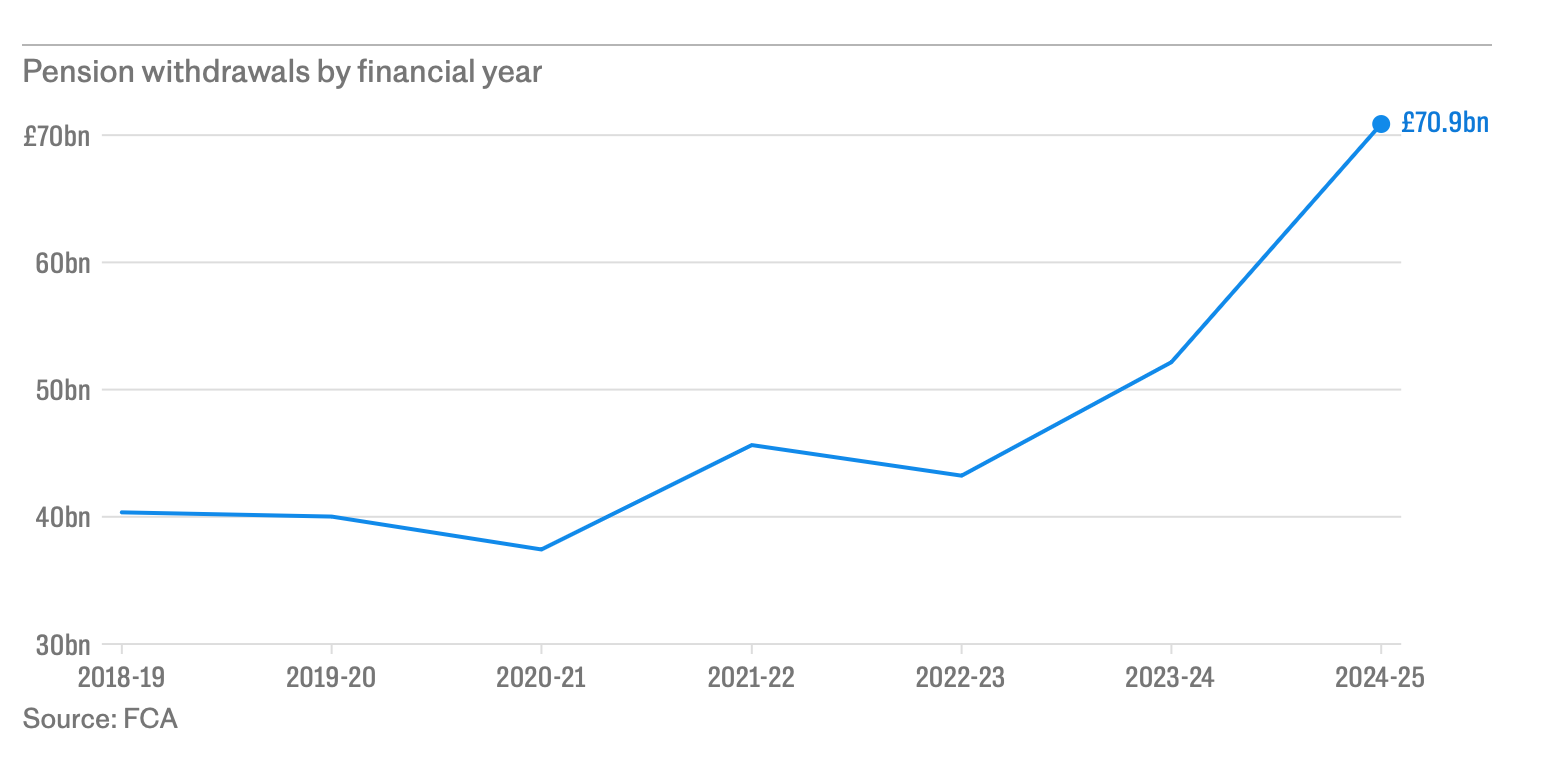
https://www.telegraph.co.uk/money/pensions/private-pensions/last-ditch-efforts-of-families-in-line-for-death-duties
1 -
Have just realised that if/when either Mr Tatters or myself die the other one will have to pay inheritance tax on the other half of our house as we’r not married.We’ve been together for 25 years yet that won’t count. We don’t have kids. Is there any way round this? I’m guessing not. Otherwise we will have to get married sharpish if one of us looks a bit off colour.0
-
Is Joint Tenants rather than Joint Owners what you need to consider for your property?Arsenetatters said:Have just realised that if/when either Mr Tatters or myself die the other one will have to pay inheritance tax on the other half of our house as we’r not married.We’ve been together for 25 years yet that won’t count. We don’t have kids. Is there any way round this? I’m guessing not. Otherwise we will have to get married sharpish if one of us looks a bit off colour.0 -
Sponsored links:
-
Quick legal civil partnership? might be the cheapest and easiest way around it?Arsenetatters said:Have just realised that if/when either Mr Tatters or myself die the other one will have to pay inheritance tax on the other half of our house as we’r not married.We’ve been together for 25 years yet that won’t count. We don’t have kids. Is there any way round this? I’m guessing not. Otherwise we will have to get married sharpish if one of us looks a bit off colour.0 -
valleynick66 said:Arsenetatters said:Have just realised that if/when either Mr Tatters or myself die the other one will have to pay inheritance tax on the other half of our house as we’r not married.We’ve been together for 25 years yet that won’t count. We don’t have kids. Is there any way round this? I’m guessing not. Otherwise we will have to get married sharpish if one of us looks a bit off colour.I think because we leave our half to each other it’s still liable for inheritance tax?0
-
That’s what our friends have just done as they have the same problem.cantersaddick said:
Quick legal civil partnership? might be the cheapest and easiest way around it?Arsenetatters said:Have just realised that if/when either Mr Tatters or myself die the other one will have to pay inheritance tax on the other half of our house as we’r not married.We’ve been together for 25 years yet that won’t count. We don’t have kids. Is there any way round this? I’m guessing not. Otherwise we will have to get married sharpish if one of us looks a bit off colour.I’ve been married twice before so kind of given that up!1 -
It's the problem with continually freezing tax thresholds. It brings a lot of people into tax (IHT in this case) that really shouldn't be. Even being married only delays the problems until the 2nd one of you passes.0
-
Plenty of ways to mitigate or avoid IHT.redman said:It's the problem with continually freezing tax thresholds. It brings a lot of people into tax (IHT in this case) that really shouldn't be. Even being married only delays the problems until the 2nd one of you passes.0 -
I have an ISA with Fundsmith. This is an active fund, which is unusual for me as I've always been a pretty passive investor.
Anyway it has underperformed recently as the Fund was down by 2.9% in the first six months of the year, 14.1percentage points less than what is perhaps the most obvious comparator — the MSCI World Index (£ net). Their half year report included some quite alarming comments and conclusions:
1. UK All Share tracker has made 66% over the past five years, trouncing the average UK equity fund’s return of just32%. This is seen as a reason to switch even more money from active to passive and so reinforce the feedback loop.2. it makes a nonsense of that original ‘settling-for-average’ argument. It also poses the question: If the tracker can perform 29% better than the average active manager, why can’t it perform 29% worse?
3 Index funds now ‘dominate the fund performance tables. In 2026 it’s filled with index funds: 12 of the top 20 performers over five years are trackers4. even more pertinent for the US market where the AI plays dominate the indices and the market performance. The US market delivered a total return of 83% over the five years to the end of May in USD (price return was 71%). Meanwhile the average open-ended equity fund investing in the US , returned 59% in USD. So index funds outperformed active funds on average by 24%.5. active fund managers are an even smaller minority than this implies, having been 80% oftrades in the 1990s, active funds share of trades is now down to just 10%. The trading activity which drives prices is now driven not by active fund management decisions but by the momentum feedback loop of funds moving from active to passive and reweighting within passive funds.
6. In 2007–08, the S&P fell 57% in five months. Next time round, it would not surprise me if it accomplished this in five days
7. companies (on Russell 2000 Index) with negative earnings have been outperforming those which are profitable and continue to do so.
8. Their conclusion is basically to continue their strategy of buying good companies. Factors included in their assessment are (with their current portfolio in brackets ) a) high ROCE (31%) b) gross margin (62%) c) operating margin (29%) d) cash conversion (92%) e) interest cover (43x) f) free cash flow yield (4.3% this is now less than 2% on S&P due to AI 'arms race')
Anyway these are their views, which I found interesting. Make of it what you will. I'm not sure what, if any, action I will take.0 -
Totally agree. Husband starts a new job next week (private equity) and will give it 6 months and broach the subject of opening an office in jersey or Singapore (partners are stationed all over the world do makes no difference). So disillusioned with this country and constant tax grab and kids are keen to start careers away from LondonAndyG said:
We are also seriously considering this it is a mystery to me how our politicians can’t see what they are doing. We have worked hard and built a decent business over the last 40 years, never avoided paying tax and have paid a fortune over the years willingly but they are not grabbing what is ours having built it with money where tax has already been taken. All this program of trying to grab IHT will do is remove the £ from hereRob7Lee said:
If I did move away, I’d keep almost nothing in the uk, certainly sub £750kPragueAddick said:
If you do get serious about moving away, you'll want to acquaint yourself with the revised IHT rules for non-residents. This is what I've been focused on in the last few months. Basically, even though you are non-resident, you will still be liable for IHT on what they call UK-situs assets above your regular IHT limit. That would include your property as well as any savings and investments that are held in British institutions. Curiously, gilts are exempt from that, which is exactly why I've been buying a load of them in the last few months.Rob7Lee said:
The more of this I hear, the more it tempts me to move away from the UK.bobmunro said:Anyone else pick up on this (apologies if already posted).Lesson here - don't leave the large family home to your children. Significantly trade down or even sell and rent in older age.
that said, I’m seriously considering just taking on a decent amount of borrowing, buy my kids a house each and hope either my wife or I live 7 years. May as well be me paying the interest, then hopefully won’t be much left when I do pop my clogs and the family home would just have the debt my children would have had anyway, may even get away with no IHT.
otherwise as you say, would have to trade down in value.4 -
There is some reasoning why in the US equity sector Index funds are topping the charts- Open ended funds are limited to how much they can invest in a single company and also limited to how few funds they can hold. The "Magnificent Seven" makes up around 30% of the entire US sector - an open ended fund just can't replicate that. They have to be more diverse, and then if the tech giants share prices outperform the general market (which they have - just compare the Nasdaq to the Dow Jones) then non-Index funds suffer.redman said:I have an ISA with Fundsmith. This is an active fund, which is unusual for me as I've always been a pretty passive investor.
Anyway it has underperformed recently as the Fund was down by 2.9% in the first six months of the year, 14.1percentage points less than what is perhaps the most obvious comparator — the MSCI World Index (£ net). Their half year report included some quite alarming comments and conclusions:
1. UK All Share tracker has made 66% over the past five years, trouncing the average UK equity fund’s return of just32%. This is seen as a reason to switch even more money from active to passive and so reinforce the feedback loop.2. it makes a nonsense of that original ‘settling-for-average’ argument. It also poses the question: If the tracker can perform 29% better than the average active manager, why can’t it perform 29% worse?
3 Index funds now ‘dominate the fund performance tables. In 2026 it’s filled with index funds: 12 of the top 20 performers over five years are trackers4. even more pertinent for the US market where the AI plays dominate the indices and the market performance. The US market delivered a total return of 83% over the five years to the end of May in USD (price return was 71%). Meanwhile the average open-ended equity fund investing in the US , returned 59% in USD. So index funds outperformed active funds on average by 24%.5. active fund managers are an even smaller minority than this implies, having been 80% oftrades in the 1990s, active funds share of trades is now down to just 10%. The trading activity which drives prices is now driven not by active fund management decisions but by the momentum feedback loop of funds moving from active to passive and reweighting within passive funds.
6. In 2007–08, the S&P fell 57% in five months. Next time round, it would not surprise me if it accomplished this in five days
7. companies (on Russell 2000 Index) with negative earnings have been outperforming those which are profitable and continue to do so.
8. Their conclusion is basically to continue their strategy of buying good companies. Factors included in their assessment are (with their current portfolio in brackets ) a) high ROCE (31%) b) gross margin (62%) c) operating margin (29%) d) cash conversion (92%) e) interest cover (43x) f) free cash flow yield (4.3% this is now less than 2% on S&P due to AI 'arms race')
Anyway these are their views, which I found interesting. Make of it what you will. I'm not sure what, if any, action I will take.
This is different elsewhere and I can show you half a dozen funds in all of the other equity sectors where active funds are outperforming Index funds. The only sectors where Index funds are in amongst the top 10 are the UK equity income sector and the Asian (ex Japan) sector.
FWIW, Fundsmith is an awful fund. I know Jupiter Merlin like it and have it in their portfolio funds, but I wouldn't touch it with a barge pole.
If you want a global fund look at Artemis Global Income instead.2 -
Getting legally married is by far the easiest thing, chap at my work did the same last year after a close friend died and he saw the agro that not being married caused (young kids involved), he was only out of the office for about two hours!Arsenetatters said:
That’s what our friends have just done as they have the same problem.cantersaddick said:
Quick legal civil partnership? might be the cheapest and easiest way around it?Arsenetatters said:Have just realised that if/when either Mr Tatters or myself die the other one will have to pay inheritance tax on the other half of our house as we’r not married.We’ve been together for 25 years yet that won’t count. We don’t have kids. Is there any way round this? I’m guessing not. Otherwise we will have to get married sharpish if one of us looks a bit off colour.I’ve been married twice before so kind of given that up!
But that does just kick the IHT can down the road, but that may be all you wish to do.1 -
Thanks for the added info.golfaddick said:
There is some reasoning why in the US equity sector Index funds are topping the charts- Open ended funds are limited to how much they can invest in a single company and also limited to how few funds they can hold. The "Magnificent Seven" makes up around 30% of the entire US sector - an open ended fund just can't replicate that. They have to be more diverse, and then if the tech giants share prices outperform the general market (which they have - just compare the Nasdaq to the Dow Jones) then non-Index funds suffer.redman said:I have an ISA with Fundsmith. This is an active fund, which is unusual for me as I've always been a pretty passive investor.
Anyway it has underperformed recently as the Fund was down by 2.9% in the first six months of the year, 14.1percentage points less than what is perhaps the most obvious comparator — the MSCI World Index (£ net). Their half year report included some quite alarming comments and conclusions:
1. UK All Share tracker has made 66% over the past five years, trouncing the average UK equity fund’s return of just32%. This is seen as a reason to switch even more money from active to passive and so reinforce the feedback loop.2. it makes a nonsense of that original ‘settling-for-average’ argument. It also poses the question: If the tracker can perform 29% better than the average active manager, why can’t it perform 29% worse?
3 Index funds now ‘dominate the fund performance tables. In 2026 it’s filled with index funds: 12 of the top 20 performers over five years are trackers4. even more pertinent for the US market where the AI plays dominate the indices and the market performance. The US market delivered a total return of 83% over the five years to the end of May in USD (price return was 71%). Meanwhile the average open-ended equity fund investing in the US , returned 59% in USD. So index funds outperformed active funds on average by 24%.5. active fund managers are an even smaller minority than this implies, having been 80% oftrades in the 1990s, active funds share of trades is now down to just 10%. The trading activity which drives prices is now driven not by active fund management decisions but by the momentum feedback loop of funds moving from active to passive and reweighting within passive funds.
6. In 2007–08, the S&P fell 57% in five months. Next time round, it would not surprise me if it accomplished this in five days
7. companies (on Russell 2000 Index) with negative earnings have been outperforming those which are profitable and continue to do so.
8. Their conclusion is basically to continue their strategy of buying good companies. Factors included in their assessment are (with their current portfolio in brackets ) a) high ROCE (31%) b) gross margin (62%) c) operating margin (29%) d) cash conversion (92%) e) interest cover (43x) f) free cash flow yield (4.3% this is now less than 2% on S&P due to AI 'arms race')
Anyway these are their views, which I found interesting. Make of it what you will. I'm not sure what, if any, action I will take.
This is different elsewhere and I can show you half a dozen funds in all of the other equity sectors where active funds are outperforming Index funds. The only sectors where Index funds are in amongst the top 10 are the UK equity income sector and the Asian (ex Japan) sector.
FWIW, Fundsmith is an awful fund. I know Jupiter Merlin like it and have it in their portfolio funds, but I wouldn't touch it with a barge pole.
If you want a global fund look at Artemis Global Income instead.
Out of interest why do you say Fundsmith is an awful fund? Until relatively recently I have done pretty well out of it and it still outperforms the market since inception.
Incidentally it only represents a relatively small % of my portfolio. Thanks for the tip on Artemis though.0 -
Sponsored links:
-
My go to fundgolfaddick said:
There is some reasoning why in the US equity sector Index funds are topping the charts- Open ended funds are limited to how much they can invest in a single company and also limited to how few funds they can hold. The "Magnificent Seven" makes up around 30% of the entire US sector - an open ended fund just can't replicate that. They have to be more diverse, and then if the tech giants share prices outperform the general market (which they have - just compare the Nasdaq to the Dow Jones) then non-Index funds suffer.redman said:I have an ISA with Fundsmith. This is an active fund, which is unusual for me as I've always been a pretty passive investor.
Anyway it has underperformed recently as the Fund was down by 2.9% in the first six months of the year, 14.1percentage points less than what is perhaps the most obvious comparator — the MSCI World Index (£ net). Their half year report included some quite alarming comments and conclusions:
1. UK All Share tracker has made 66% over the past five years, trouncing the average UK equity fund’s return of just32%. This is seen as a reason to switch even more money from active to passive and so reinforce the feedback loop.2. it makes a nonsense of that original ‘settling-for-average’ argument. It also poses the question: If the tracker can perform 29% better than the average active manager, why can’t it perform 29% worse?
3 Index funds now ‘dominate the fund performance tables. In 2026 it’s filled with index funds: 12 of the top 20 performers over five years are trackers4. even more pertinent for the US market where the AI plays dominate the indices and the market performance. The US market delivered a total return of 83% over the five years to the end of May in USD (price return was 71%). Meanwhile the average open-ended equity fund investing in the US , returned 59% in USD. So index funds outperformed active funds on average by 24%.5. active fund managers are an even smaller minority than this implies, having been 80% oftrades in the 1990s, active funds share of trades is now down to just 10%. The trading activity which drives prices is now driven not by active fund management decisions but by the momentum feedback loop of funds moving from active to passive and reweighting within passive funds.
6. In 2007–08, the S&P fell 57% in five months. Next time round, it would not surprise me if it accomplished this in five days
7. companies (on Russell 2000 Index) with negative earnings have been outperforming those which are profitable and continue to do so.
8. Their conclusion is basically to continue their strategy of buying good companies. Factors included in their assessment are (with their current portfolio in brackets ) a) high ROCE (31%) b) gross margin (62%) c) operating margin (29%) d) cash conversion (92%) e) interest cover (43x) f) free cash flow yield (4.3% this is now less than 2% on S&P due to AI 'arms race')
Anyway these are their views, which I found interesting. Make of it what you will. I'm not sure what, if any, action I will take.
This is different elsewhere and I can show you half a dozen funds in all of the other equity sectors where active funds are outperforming Index funds. The only sectors where Index funds are in amongst the top 10 are the UK equity income sector and the Asian (ex Japan) sector.
FWIW, Fundsmith is an awful fund. I know Jupiter Merlin like it and have it in their portfolio funds, but I wouldn't touch it with a barge pole.
If you want a global fund look at Artemis Global Income instead.
0 -
If like me you have UK shares and funds held on a UK based platform, such as H-L they fall into the IHT net. If the platform is based abroad, such as IBKR or Degiro, they are safe. But good luck finding the European equivalent of the best funds and shares I own, on those platforms. I still need to clarify what is and isn't safe within my SIPP wrapper, although they are not brought into the new regime until April next year.Rob7Lee said:
If I did move away, I’d keep almost nothing in the uk, certainly sub £750kPragueAddick said:
If you do get serious about moving away, you'll want to acquaint yourself with the revised IHT rules for non-residents. This is what I've been focused on in the last few months. Basically, even though you are non-resident, you will still be liable for IHT on what they call UK-situs assets above your regular IHT limit. That would include your property as well as any savings and investments that are held in British institutions. Curiously, gilts are exempt from that, which is exactly why I've been buying a load of them in the last few months.Rob7Lee said:
The more of this I hear, the more it tempts me to move away from the UK.bobmunro said:Anyone else pick up on this (apologies if already posted).Lesson here - don't leave the large family home to your children. Significantly trade down or even sell and rent in older age.
that said, I’m seriously considering just taking on a decent amount of borrowing, buy my kids a house each and hope either my wife or I live 7 years. May as well be me paying the interest, then hopefully won’t be much left when I do pop my clogs and the family home would just have the debt my children would have had anyway, may even get away with no IHT.
otherwise as you say, would have to trade down in value.1 -
IBKR is what I looked at, but haven’t gone into great depth. I know people in Guernsey and IOM who have moved everything, so bar an account with a few thousand in it, nothing else.PragueAddick said:
If like me you have UK shares and funds held on a UK based platform, such as H-L they fall into the IHT net. If the platform is based abroad, such as IBKR or Degiro, they are safe. But good luck finding the European equivalent of the best funds and shares I own, on those platforms. I still need to clarify what is and isn't safe within my SIPP wrapper, although they are not brought into the new regime until April next year.Rob7Lee said:
If I did move away, I’d keep almost nothing in the uk, certainly sub £750kPragueAddick said:
If you do get serious about moving away, you'll want to acquaint yourself with the revised IHT rules for non-residents. This is what I've been focused on in the last few months. Basically, even though you are non-resident, you will still be liable for IHT on what they call UK-situs assets above your regular IHT limit. That would include your property as well as any savings and investments that are held in British institutions. Curiously, gilts are exempt from that, which is exactly why I've been buying a load of them in the last few months.Rob7Lee said:
The more of this I hear, the more it tempts me to move away from the UK.bobmunro said:Anyone else pick up on this (apologies if already posted).Lesson here - don't leave the large family home to your children. Significantly trade down or even sell and rent in older age.
that said, I’m seriously considering just taking on a decent amount of borrowing, buy my kids a house each and hope either my wife or I live 7 years. May as well be me paying the interest, then hopefully won’t be much left when I do pop my clogs and the family home would just have the debt my children would have had anyway, may even get away with no IHT.
otherwise as you say, would have to trade down in value.0 -
Not sure about the tax implications, but IBKR are great, can't fault them.Rob7Lee said:
IBKR is what I looked at, but haven’t gone into great depth. I know people in Guernsey and IOM who have moved everything, so bar an account with a few thousand in it, nothing else.PragueAddick said:
If like me you have UK shares and funds held on a UK based platform, such as H-L they fall into the IHT net. If the platform is based abroad, such as IBKR or Degiro, they are safe. But good luck finding the European equivalent of the best funds and shares I own, on those platforms. I still need to clarify what is and isn't safe within my SIPP wrapper, although they are not brought into the new regime until April next year.Rob7Lee said:
If I did move away, I’d keep almost nothing in the uk, certainly sub £750kPragueAddick said:
If you do get serious about moving away, you'll want to acquaint yourself with the revised IHT rules for non-residents. This is what I've been focused on in the last few months. Basically, even though you are non-resident, you will still be liable for IHT on what they call UK-situs assets above your regular IHT limit. That would include your property as well as any savings and investments that are held in British institutions. Curiously, gilts are exempt from that, which is exactly why I've been buying a load of them in the last few months.Rob7Lee said:
The more of this I hear, the more it tempts me to move away from the UK.bobmunro said:Anyone else pick up on this (apologies if already posted).Lesson here - don't leave the large family home to your children. Significantly trade down or even sell and rent in older age.
that said, I’m seriously considering just taking on a decent amount of borrowing, buy my kids a house each and hope either my wife or I live 7 years. May as well be me paying the interest, then hopefully won’t be much left when I do pop my clogs and the family home would just have the debt my children would have had anyway, may even get away with no IHT.
otherwise as you say, would have to trade down in value.0 -
Good to know, they also pay a decent rate on cash balances.CAFCsayer said:
Not sure about the tax implications, but IBKR are great, can't fault them.Rob7Lee said:
IBKR is what I looked at, but haven’t gone into great depth. I know people in Guernsey and IOM who have moved everything, so bar an account with a few thousand in it, nothing else.PragueAddick said:
If like me you have UK shares and funds held on a UK based platform, such as H-L they fall into the IHT net. If the platform is based abroad, such as IBKR or Degiro, they are safe. But good luck finding the European equivalent of the best funds and shares I own, on those platforms. I still need to clarify what is and isn't safe within my SIPP wrapper, although they are not brought into the new regime until April next year.Rob7Lee said:
If I did move away, I’d keep almost nothing in the uk, certainly sub £750kPragueAddick said:
If you do get serious about moving away, you'll want to acquaint yourself with the revised IHT rules for non-residents. This is what I've been focused on in the last few months. Basically, even though you are non-resident, you will still be liable for IHT on what they call UK-situs assets above your regular IHT limit. That would include your property as well as any savings and investments that are held in British institutions. Curiously, gilts are exempt from that, which is exactly why I've been buying a load of them in the last few months.Rob7Lee said:
The more of this I hear, the more it tempts me to move away from the UK.bobmunro said:Anyone else pick up on this (apologies if already posted).Lesson here - don't leave the large family home to your children. Significantly trade down or even sell and rent in older age.
that said, I’m seriously considering just taking on a decent amount of borrowing, buy my kids a house each and hope either my wife or I live 7 years. May as well be me paying the interest, then hopefully won’t be much left when I do pop my clogs and the family home would just have the debt my children would have had anyway, may even get away with no IHT.
otherwise as you say, would have to trade down in value.0 -
Good news on the premium bond front.
The prize fund rate has been increased from 3.30% to 3.80%. An additional £57 million has been added to the prize fund with over 271,000 more prizes up for grabs. The odds of each Bond winning have improved from 23,000 to 1 to 22,000 to 1.
Hopefully more chances to win for Lifers with premium bonds!!5 -
Where has that money come from ? I thought the country was skint !Fortune 82nd Minute said:Good news on the premium bond front.
The prize fund rate has been increased from 3.30% to 3.80%. An additional £57 million has been added to the prize fund with over 271,000 more prizes up for grabs. The odds of each Bond winning have improved from 23,000 to 1 to 22,000 to 1.
Hopefully more chances to win for Lifers with premium bonds!!
Or the think/know the base rate is going up soon.1 -
Are the Treasury/Government allowed to borrow money secured against the volume of cash held in Premium Bonds?0
-
Given it is a liability on the balance sheet rather than an asset, I doubt it. That money isn't sitting in an account somewhere, it's being spent, three times over probably!Carter said:Are the Treasury/Government allowed to borrow money secured against the volume of cash held in Premium Bonds?
Nothing would surprise me though!1 -
2 other pieces of financial news I picked up upon today......
1) SpaceX shares are now lower than their original release price.
2) trillions of dollars have flowed out of Nvida and other semi-conducter shares in July......and mainly into the Mag7 companies. Wall Street are now awaiting the results of the big tech companies and if they disappoint then.......???0