Statins
Comments
-
Mrs Idle follows that sort of philosophy much more assiduously than I do (she's vegetarian and gluten intolerant) and cooks from scratch most nights. She loves to chop an onion!But its amazing how quickly the new, better diet becomes normal and you feel healthier after eating rather than bloated and lethargic.I still love cheese and a bit of well-cooked steak but in very limited quantities now, and fish and salad are delicious if you use a bit of imagination. I make muesli at home with gluten free oats, chopped mixed nuts, chia seeds, sultanas and some dried cranberries/mango pieces and it's every bit as good as anything you'd buy in a packet.Coconut oil is to be avoided as much as possible. You might think it's some sort of healthy alternative but it's 87% saturated fat. My clogged arteries wouldn't last five minutes if I ate that shit.4
-
It is a pleasure to help anyone, particularly a fellow Addick. I have spent 10 years researching healthy nutrition and am happy to share what I’ve learned with anyone who wants to listen.
Your wake-up call was me 10 years ago. I was surprised to find white bread—with a few exceptions—is actually considered an ultra-processed food (check out the ingredients!). White rice is also not as nutritionally good as brown rice, but whether a food is 'good' or 'bad' often comes down to what you would have eaten instead. Swapping that white toast for raw vegetables is a massive win! For deep dives into the science, the NutritionFacts.org website is the best source of information I have found . Dr Greger’s articles always reference the trials and papers from which he draws his conclusions.
I’m not a baker myself, but I have eaten plenty of vegan cakes. Since your neighbour runs a micro-bakery, maybe ask whether a Whole Food, Plant-Based (WFPB) range would be commercially viable? If only people were aware there would surely be a market of health-conscious people looking for treats that skip the processed oils and refined sugars with no downside to consumption?
NutritionFacts.org also features complete WFPB meals including desserts if you get stuck for ideas.
4 -
Your results are very encouraging. Dropping your HbA1c from 7.3 to 6.2 and losing 4kg in just three months after 24 years of diabetes is proof of how fast the body can heal when you change what is at the end of your fork.
I am not a doctor, but have spent the last 10 years following evidence-based nutrition with a whole food plant-based diet.
Why Oats Work So Well
Science backs up your medical nutritionist's advice to include oats. According to peer-reviewed data compiled by NutritionFacts.org, oats contain a unique soluble fiber called beta-glucan. [1]
- This fiber forms a thick gel in your digestive tract.
- It slows down the absorption of carbohydrates.
- It releases glucose slowly, preventing sharp sugar spikes.
- It acts like a giant sponge, binding to cholesterol in your gut.
- The less processed the oats are, the better they work. [1, 2, 3]
The Power of Flaxseeds
If you want to boost your results even further, consider adding a daily tablespoon of ground flaxseeds to your morning oats. Clinical studies shared on the NutritionFacts.org Flaxseeds for Diabetes Blog show that a single tablespoon of ground flaxseed powder daily can: [1, 2]
- Significantly improve fasting blood sugars.
- Drop triglycerides and lower HbA1c levels over time.
- Improve insulin sensitivity.
- Helps protect your blood vessels and heart. [1, 2, 3, 4, 5]
Dr. Greger's Insights on Reversing Type 2 Diabetes
In his medical literature reviews, featured on the NutritionFacts.org Diabetes Health Topic Page, Dr. Michael Greger emphasizes that Type 2 diabetes is not necessarily a permanent, progressive disease. His research highlights three main keys: [1]
- Root Cause: Insulin resistance is heavily driven by "fat toxicity"—the buildup of excess fat inside muscle and liver cells, which blocks insulin from moving glucose out of the blood. [1]
- Dietary Reversal: A whole-food, plant-based diet can stop this fat buildup, fundamentally altering the course of the disease and dropping blood sugar naturally. [1, 2]
- Long-Term Remission: Studies show that people who have lived with diabetes for decades can still achieve substantial, rapid drops in blood glucose and safely reduce or eliminate their medications through these intensive lifestyle adjustments.[1, 2]
Keep going with your dietary experiment—you are well on your way to safely reducing that medication under your doctor's supervision! [1]
P.S. You may also wish to check your B12 levels, as many people’s appear to be low, particularly if you are moving toward a plant-based diet. Here is the link to Dr. Greger's B12 guidelines: NutritionFacts.org Vitamin B12 Recommendation. [1]
Stuart_the_Red said:
I’ve been a Type 2 diabetic for the past 24 years (diagnosed at 40). My long-term blood-sugar level (Hb1ac) has always been a little higher than expected (here in France 4.5-6.5 is considered a normal level and mine was 7.3) despite all my efforts with diets, medication, etc.68/9er said:I’m not a doctor, but I have an interest in nutrition. Potentially you have a 4-week window to improve your cholesterol blood pressure and general health before your appointment.
Here is what the research (specifically from Dr. Michael Greger / nutrition facts.org - this is a free not for profit website) shows:
- High 'good' cholesterol isn't a free pass: It doesn't cancel out the risks of high 'bad' cholesterol.
- Diet can beat statins: A Whole Food, Plant-Based diet can lower cholesterol just as effectively as medication.
- Diet change: Avoid saturated fats (meat, dairy, oils) and eat more oatmeal, beans, and ground flaxseeds. • They act like a sponge to pull cholesterol out. [1, 2]
My experience: 10 years ago, I had high cholesterol, arthritis, and faced gallbladder removal. I researched a change in diet and switched to whole plant foods. Today, my cholesterol is low, my joints are pain-free, and I kept my gallbladder.
If you are prepared to modify your diet you will lower your cholesterol and be generally more healthy.
My wife has had problems losing weight and she consulted a medical nutritionist and discussed various options.
We now follow a more whole-food plant based diet and eat poultry and fish for protein with a lot of fresh vegetables and have upped our intake of oats.
We have oat days once a week where we eat nothing but oats (with Shia seeds and a little bit of fruit in the morning, savoury ingredients at lunch and in the evening we can choose either fruit or savoury again).
There’s also the option of doing a full 3-day oat cure to start off where you eat nothing but oats in various forms, but at the moment that’s a little extreme for me.
My last Hb1ac blood test in March was 7.3 and immediately afterwards I started the oat- and vegetable-based diet. Last week my follow up test showed that my level had gone down to 6.2.
I’m really happy with that and it has encouraged me to carry on to see if it’s not possible to reach a level where I can reduce the medication needed to keep the diabetes in check!
Oh! And I lost 4kgs in that first 3 months!
1 -
Arsenetatters said:
I eat a plant based diet but my downfall is sweet stuff. I’m not overweight, BMI 23 but I absolutely love cake and now I’m retired its intake has increased. I’m also not a great eater and skip meals if I’m busy spending my whole diet needs a look at.68/9er said:I’m not a doctor, but I have an interest in nutrition. Potentially you have a 4-week window to improve your cholesterol blood pressure and general health before your appointment.
Here is what the research (specifically from Dr. Michael Greger / nutrition facts.org - this is a free not for profit website) shows:
- High 'good' cholesterol isn't a free pass: It doesn't cancel out the risks of high 'bad' cholesterol.
- Diet can beat statins: A Whole Food, Plant-Based diet can lower cholesterol just as effectively as medication.
- Diet change: Avoid saturated fats (meat, dairy, oils) and eat more oatmeal, beans, and ground flaxseeds. • They act like a sponge to pull cholesterol out. [1, 2]
My experience: 10 years ago, I had high cholesterol, arthritis, and faced gallbladder removal. I researched a change in diet and switched to whole plant foods. Today, my cholesterol is low, my joints are pain-free, and I kept my gallbladder.
If you are prepared to modify your diet you will lower your cholesterol and be generally more healthy.
I also have arthritis (psoriatic) and managed to get my information markers down to zero with cherry juice and a more balanced diet but the markers have gone up again.I think I’ve just taken me eye off the ball and need to get back to healthy eating. I’d rather do that than statins.Thank you for this
I’m not a doctor or nutritionalist.
Not for statins, I’d tell any Doctor who suggests those to me to go fuck themselves, but for other markers that have occasionally have gone a bit higher or lower and there have been pills and injections offered I’ve opted to go down the I’ll try fixing it myself route as well. Ie a slight adjustments to diet. Personally, I think you’ve got it right.
’cakes’ sounds like the big red flag to
me. Like most things, occasionally is fine but anything like that you are eating regularly is a wake up call to knock it on the head, those and the biggest culprit, biscuits. You might want to try switching to eating dark chocolate, preferably just plain (ie no flavours - added sugar) and 70% to 85%. It’s actually good for you and the bitterness, once you’ve got used to it, will stop the cravings for the sweet stuff that’s basically bad for you. You should only be eating small portion of it in any one day so that balances out the price difference you will be paying for a decent bar of it.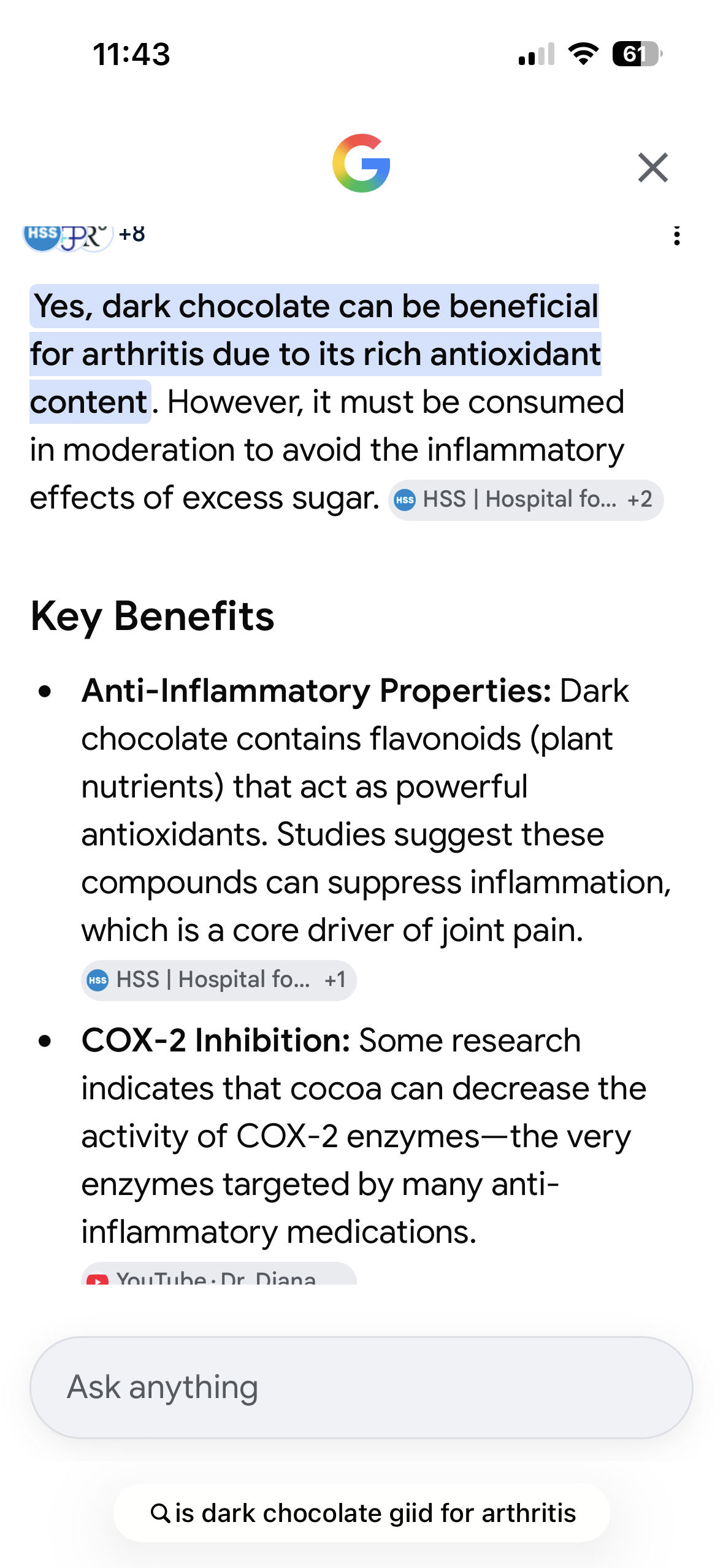
1 -
Thank you. I don’t eat dairy so dark chocolate is the one for me. You’ve reminded me about it because when my inflammation markers went up I looked into foods that help lower inflammation and dark chocolate was one. I’ve stopped having it in place of sweet sugary cupcakes and biscuits. I think I’ve just taken my eye off the ball diet wise. I’m not overweight but my BMI is 23 now and was 22. I notice it in clothes . Time to get back to healthy eating and not skipping meals.letthegoodtimesroll said:Arsenetatters said:
I eat a plant based diet but my downfall is sweet stuff. I’m not overweight, BMI 23 but I absolutely love cake and now I’m retired its intake has increased. I’m also not a great eater and skip meals if I’m busy spending my whole diet needs a look at.68/9er said:I’m not a doctor, but I have an interest in nutrition. Potentially you have a 4-week window to improve your cholesterol blood pressure and general health before your appointment.
Here is what the research (specifically from Dr. Michael Greger / nutrition facts.org - this is a free not for profit website) shows:
- High 'good' cholesterol isn't a free pass: It doesn't cancel out the risks of high 'bad' cholesterol.
- Diet can beat statins: A Whole Food, Plant-Based diet can lower cholesterol just as effectively as medication.
- Diet change: Avoid saturated fats (meat, dairy, oils) and eat more oatmeal, beans, and ground flaxseeds. • They act like a sponge to pull cholesterol out. [1, 2]
My experience: 10 years ago, I had high cholesterol, arthritis, and faced gallbladder removal. I researched a change in diet and switched to whole plant foods. Today, my cholesterol is low, my joints are pain-free, and I kept my gallbladder.
If you are prepared to modify your diet you will lower your cholesterol and be generally more healthy.
I also have arthritis (psoriatic) and managed to get my information markers down to zero with cherry juice and a more balanced diet but the markers have gone up again.I think I’ve just taken me eye off the ball and need to get back to healthy eating. I’d rather do that than statins.Thank you for this
I’m not a doctor or nutritionalist.
Not for statins, I’d tell any Doctor who suggests those to me to go fuck themselves, but for other markers that have occasionally have gone a bit higher or lower and there have been pills and injections offered I’ve opted to go down the I’ll try fixing it myself route as well. Ie a slight adjustments to diet. Personally, I think you’ve got it right.
’cakes’ sounds like the big red flag to
me. Like most things, occasionally is fine but anything like that you are eating regularly is a wake up call to knock it on the head, those and the biggest culprit, biscuits. You might want to try switching to eating dark chocolate, preferably just plain (ie no flavours - added sugar) and 70% to 85%. It’s actually good for you and the bitterness, once you’ve got used to it, will stop the cravings for the sweet stuff that’s basically bad for you. You should only be eating small portion of it in any one day so that balances out the price difference you will be paying for a decent bar of it.1