







 :-
:-Attention: Please take a moment to consider our terms and conditions before posting.
Energy Bills
Comments
-
Yeah, they say theres a combination of reason -Rob7Lee said:
I assume the £122 was no where near enough, so you are now paying the right amount plus catching up? If it's any consolation Octopus charge me £360!Gribbo said:Octopussies tekin the pish -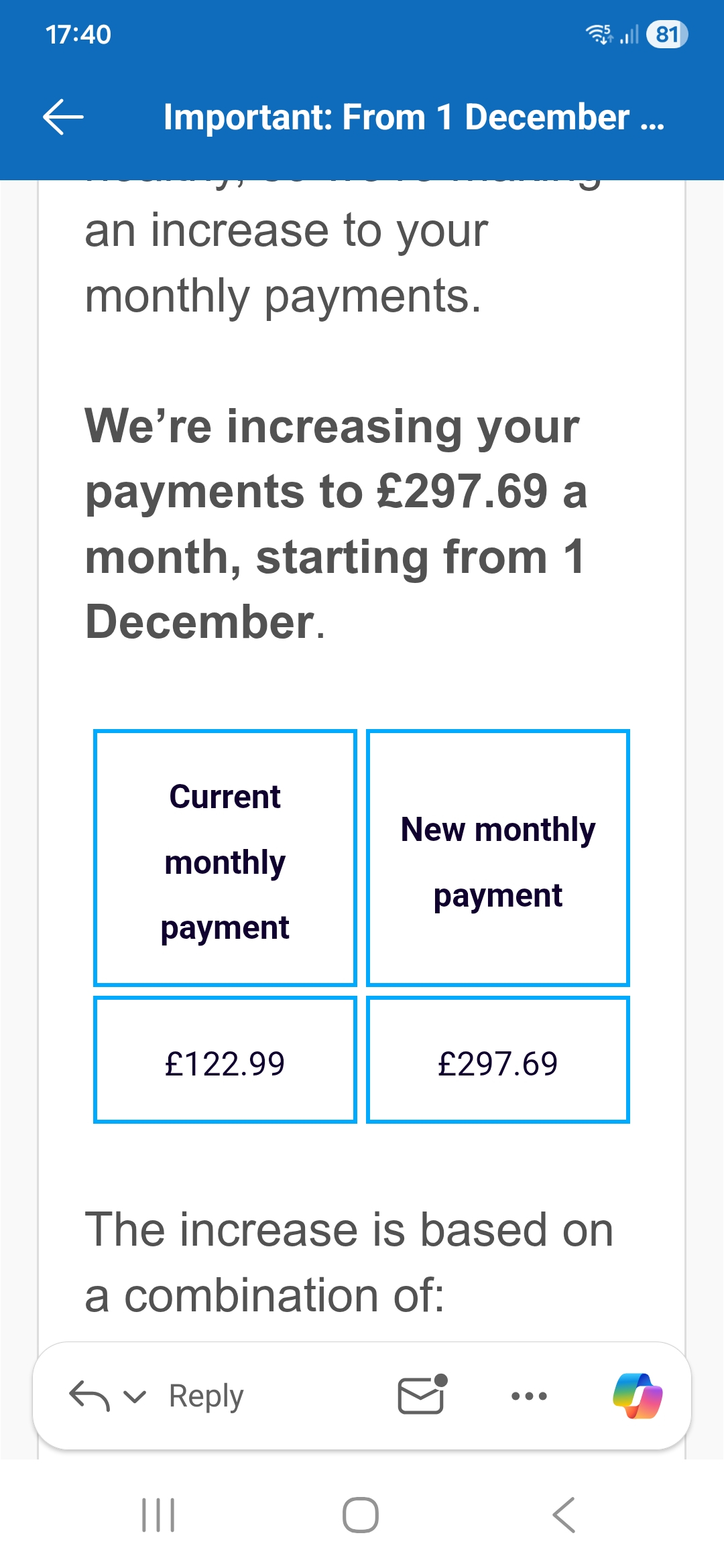
- Current energy usage- Current balance
- The future costs of your energy
Which is fair enough, but we've been with them over 3 years and it's never been flagged before, so for it to more than double overnight is a bit of a shock0 -
I would double check their claims and workings. Are you significantly in debit? If so I can understand the clawback. The other reasons do not add up.I have changed to paying the exact billed amount each month. Estimations are a con so they can bank your money and live off their customers interest.0
-
You are able to check your Octopus account online, so you can see your balance whenever you want, just like your bank account.
I pay £135pm and am £400 in credit.0 -
Posted this on the S&I thread but probably more relevant here. I've had a policy idea which I think might work but feel free to shoot down.
For Branded medicines in the UK we have two pricing schemes for pharma companies who sell in the UK. These set a limit on the revenue that can be made by the sector in the UK in any year and all revenue above that limit is clawed back by the government. Government are very careful not to call this a tax and instead present it as a saving to the NHS as that is the sole purchaser of branded medicines in the UK. However in effect it is essentially a tax and massively limits the profits of the sector. I actually think in the recent past the scheme has been too tight and we risked Pharma companies reactions but the changes to the schemes in 2024 and 2025 seem to have addressed this. There is the Voluntary Scheme: https://www.gov.uk/government/publications/2024-voluntary-scheme-for-branded-medicines-pricing-access-and-growth
And that is underpinned by a legal backstop that is the statutory scheme:https://www.gov.uk/government/consultations/proposed-review-of-the-statutory-scheme-for-branded-medicines-pricing
Why can't a similar scheme be applied to other sectors where specific conditions are found (small number of large and powerful companies making economically excess profits from essential goods). Top of that list being Energy. That would have the dual benefit of reduced prices for consumers and increased revenue for government. My very very rough calculations suggest doing similar to the energy sector could take £350 a year off the "average" energy bill, raise £10bn for the government and leave £10bn in profit for the sector.
Money raise could be used to take green subsidies off of the standing charge -reducing bills further. The rest could also be invested in building renewable infrastructure and growing the national owned GB energy company to become a genuine option as an energy generator and provider bringing prices down in the long term.
When applied to medicines this approach actually had the effect of increasing the pharma companies investment in the UK (or it did until Brexit fucked with our access to the European market) as the costs of this could be written off against the scheme and so investment represented a massive saving for them. This led to jobs and growth in the UK. This could actually encourage the fossil fuel giants to invest in renewable infrastructure.
Any reason why this wouldn't work? if we can do it to big pharma why can't we do it to energy? Most European countries have some kind of scheme to keep energy prices and company power down.
I don't think there would be any risk of them leaving the UK market as still have massive market power and captive customers.
Of course I'm not actually expecting this government to do it as their last election campaign was in part funded by those industries so I'm sure that came with promises.
2 -
I would imagine energy bills have one of the biggest inputs on growth. The Government has to sort this out as quickly as possible.1
-
I've set our radiator heating on level 15.5 and it seems okay at the moment, so long as we stay well wrapped up. Anyone have a better idea, or experience?0
-
Set it to 30 and have a Mexican themed party night4
-
We do the same & only put it on when needed.thewolfboy said:I've set our radiator heating on level 15.5 and it seems okay at the moment, so long as we stay well wrapped up. Anyone have a better idea, or experience?
Keep doors shut as necessary & block drafts.1 -
Yes, emigratethewolfboy said:I've set our radiator heating on level 15.5 and it seems okay at the moment, so long as we stay well wrapped up. Anyone have a better idea, or experience?5 -
My house never drops that low even over night! We set at 20.5, although the radiators have those thermostat things going from 0-5, depending on room set to 2-4, Kitchen (coldest room) 5.thewolfboy said:I've set our radiator heating on level 15.5 and it seems okay at the moment, so long as we stay well wrapped up. Anyone have a better idea, or experience?0 -
Sponsored links:
-
We've had to replace the boiler, so going the whole hog and upgrading the soon to be turned off Nest, for Hive and putting Digital TRVs on the radiators as well. See if that works to make the house more balanced and warmer.
Also switched to Octopus Intelligent Go for car charging fun and games0 -
me and my partner have been lucky enough to be able to make some sacrifices and use some savings to install green tech to our home. Solar panels, batteries and more recently a heat pump. Today I requested Octopus puts our bills down to £100 per month and I think even that might be too much. Our house uses a lot of electricity as its quite hi-tech, so it's been a real benefit to be able to charge the batteries on the cheap rate to the point where most of our electricity use, even with a heat pump, is on cheap night rate in winter and then mostly free in summer.
I would recommend anyone who thinks they will stay in their house long term and can afford it, to consider some green tech or anything to help with insulation and draft proofing.
7 -
I’m on the Octopus energy wholesale floating tariff. With what’s happening in the Middle East, is it worth coming off this tariff or sticking with it? I’m not sure at the moment.0
-
I have just left the octopus wholesale tracker after 3.5 years on it. My deal expired in March and the calculation between they now apply means it was cheaper for me to go to octopus agile (I have solar panels).HardyAddick said:I’m on the Octopus energy wholesale floating tariff. With what’s happening in the Middle East, is it worth coming off this tariff or sticking with it? I’m not sure at the moment.If you download this app and set it up, it will connect to your octopus account and show you a comparison between tariffs and what works out better
https://apps.apple.com/gb/app/octopus-compare/id15450040951 -
My octopus fixed rate is coming up for renewal.HardyAddick said:I’m on the Octopus energy wholesale floating tariff. With what’s happening in the Middle East, is it worth coming off this tariff or sticking with it? I’m not sure at the moment.
I'm thinking of extending for another 12 months.
Be interesting what others think.0 -
See above, compare octopus tariffs using the app and you will see actual costs (if your energy usage remains fairly consistent).blackpool72 said:
My octopus fixed rate is coming up for renewal.HardyAddick said:I’m on the Octopus energy wholesale floating tariff. With what’s happening in the Middle East, is it worth coming off this tariff or sticking with it? I’m not sure at the moment.
I'm thinking of extending for another 12 months.
Be interesting what others think.Generally speaking, some ok fixed rates out there at the moment if you don’t have an electric car, solar or batteries.0 -
I’ve just jumped from Octopus Tracker which was due to end at the end of the month anyway to a fixed tariff. I did this on day one of this war because I believe there’s only one way the wholesale prices of oil and gas are heading for the foreseeable future. If anyone is toying with getting a fix I’d really do it very quickly. The offers currently out there are likely to be withdrawn or modified to reflect the projected leap in prices.0
-
Just fixed for 12 months as I think the same as you regarding what way prices will go in the near futureShootersHillGuru said:I’ve just jumped from Octopus Tracker which was due to end at the end of the month anyway to a fixed tariff. I did this on day one of this war because I believe there’s only one way the wholesale prices of oil and gas are heading for the foreseeable future. If anyone is toying with getting a fix I’d really do it very quickly. The offers currently out there are likely to be withdrawn or modified to reflect the projected leap in prices.1 -
FWIW - here's the Martin Lewis (moneysavingexpert.com) take on it......... gives a number of scenarios and it just depends what kind of deal you're currently on..... sorry about the font, beyond my IT skills:-
Stop press: Important. UK energy wholesale rates spiking due to conflict in the Middle East
1. If you can get off the Energy Price Cap right now, you should... and urgently. The wholesale gas rate is spiking due to the Middle East conflict, up 90% on last week. This rate is a prime driver of UK electricity prices. If the spike's sustained (big if), it will likely push the Price Cap rate up from July. If you're in Eng, Scot, Wales and on your firm's standard tariff, this impacts you (see am I on the Price Cap?).
For peace of mind your price won't rise, you can fix, but many firms have already urgently repriced their cheapest fixes upwards. At the time we sent this email, you can still just about lock-in at up to 14% less than the current Cap, but it's slim pickings otherwise. Action: Compare & Fix or read Martin's Middle East conflict: Get off the Price Cap mini-briefing.
2. Ends 4pm Thu. Sticking on the Price Cap, low user or on Smart Prepay? Save £170. If you're staying on the Price Cap, quickly consider an alternative, especially good for lower users or those on Smart Prepay: the EDF Simply Tracker Extra matches the Price Cap rate (which drops 6.7% on 1 April) but with £100 lower Standing Charge for a year, plus via our link via the Energy Club you get £50 dual-fuel EDF cashback + £20 MSE cashback (both halved for elec only).
3. Already on an energy fix? See Martin's Already on an energy fix?... It'll get CHEAPER on 1 April video. It's from before the Middle East conflict started, but the concepts haven't changed.0 -
I was asked on another (now closed) thread about my Solar panels. There was interest in my personal experience, @CaptainRobbo @Rob7Lee @valleynick66 so I thought I would follow up here. To clarify a couple of things; £3k saving I said was slightly ambitious and slightly tongue in cheek due to possible price rises! £2.5k would have been more accurate but maybe not really the correct answer either! This is because my actual electricity saving is high but it’s a bit of a false figure due to the massively increased electricity use due to a heat pump and the difference between gas and even cheap rate electricity.
System cost:
14 Solar panels (5kwh) & 2 batteries (6.5kwh usable) in 2022 cost: £10.5k (we factored this in as a moving house cost)
Heat pump 2025: a little over £1k with the government grant (our house needed very little upgrading as it is modern and has wet underfloor heating)
Extra battery for additional heat pump requirement: £1k
Total: £12.5k
Our house was built in 2017 and has lots of “smart home” things going on when we bought it! Speakers everywhere, a 6ft tall server rack stuffed full of media things and air con which we only use on the hottest days. When I’ve compared it to my parents, small 4 bedroom house built c.1990, my modern, large 4 bed room house uses twice as much electricity as theirs does just sitting there during the day with no one home!
Prior to the heat pump my yearly savings on just solar were around £1100 in 2022 (only 9 months but high prices), 2023: £1200, 2024: £900. (no battery charging included) So around 9 to 10 years to “pay off” if only using solar generation, 10 years is the figure normally given so I can say that was originally accurate for me. However, there are other ways to save money with the solar that are less obvious (see below!) Also, next to no other home improvements pay you anything back, so to have something that actually can is fantastic!
Solar is great in the summer especially but not so much in the winter. It could produce as little as 56kwh in December but 730kwh is the record for a month in summer. (we did have really tall trees in a neighbour’s garden which shaded the solar panels in any December sunlight, these have now been taken down but I don’t expect a huge improvement!)
What wasn’t particularly explained to me by the solar install company was how useful cheap rate charging is so I didn’t have this set up for the first few years. This is where you can save quite a lot of money in those winter months which negates the argument of a solar install being only a summer thing. I have 3 batteries that total around 11kwh capacity. Currently for electricity I pay 26p regular rate but 11p for cheap Octopus Flux rate. This tariff, which you can only access if you have a heat pump, gives me 3 cheap rate charging times spread out during the day. Because of this I don’t need a huge battery capacity to be able to run the whole house mostly on cheap rate electricity. 80% of the electricity I import is 11p instead of 25p.
If I try and ignore the heat pump, and just look at savings for solar panels and cheap rate charging of batteries only. So far in 2026, its £400 for solar that I use directly, £65 in exports and £330 in cheap rate charging (mostly over winter). That would mean £1900 saving in 12 months at which rate the “payback” for the system for me is 5.5 years. A big difference from 9 to 10 for just using the solar generation alone.
Regarding the heat pump, it is more expensive to run than gas UNLESS you can power it mostly on cheap rate electricity, which I can. So it’s very important that you have a plan for this if you are going to switch. I’ve not had it for long but I think it will save about £350 per year when compared to gas (would be more but I still have a gas hob so can’t ditch gas completely) For me this means “paying back” the heat pump in 5.5 years for the heat pump and extra battery. Day-to-day for my house, if the temperature is close to zero all day, the heat pump is more expensive to use than gas, even on cheap rate electricity. But anything over 5 degree’s and the heat pump is always cheaper. It's very different with the house being heated with a heat pump and underfloor heating. You dont ever really notice the heating being on, its just the temperature that you want it to be. Never too warm and never too cold! I'm pretty happy with it!
4 -
Sponsored links:
-
What I would say about the cheap overnight rates is don't bank on these long term. Octopus is already messing around with their Intelligent Octopus Go tariff. My crystal ball tells me about another 5 years of cheap regular overnight electricity. After that I think they will adjust these so fewer slots and more dynamic pricing like the flux tariff4
-
Thank you @arthur. That’s a really useful summary. It’s good it’s working for you and my only real observation is that it would appear that your home circa 2017 is pretty much ideal for your solar power and heat pump set up. I wonder how you could overlay this onto an average British home. Sounds to me like it’s unlikely to achieve the same energy efficiency or cost savings. At an installation cost of £12k I’m guessing it’s very much a non starter for most people and most homes. I’d certainly be interested to hear both yours and other comments on my assessment which is based on nothing more than an interested party.2
-
I think that solar would work well on any home that has a roof but with batteries its a lot better. That is not always quite as straight forward. There isnt anything specific about the age of the house that I can think of that would cause a problem for solar panels.ShootersHillGuru said:Thank you @arthur. That’s a really useful summary. It’s good it’s working for you and my only real observation is that it would appear that your home circa 2017 is pretty much ideal for your solar power and heat pump set up. I wonder how you could overlay this onto an average British home. Sounds to me like it’s unlikely to achieve the same energy efficiency or cost savings. At an installation cost of £12k I’m guessing it’s very much a non starter for most people and most homes. I’d certainly be interested to hear both yours and other comments on my assessment which is based on nothing more than an interested party.
Heat pump is different, and my house was perfect for it, which was lucky. But it can work well in any home but at extra cost, what those costs are can vary massively but some of them could be optional things that just make the heat pump work better. Some of these costs are general home improvements like extra insulation or draft proofing that would reduce your bills if you had any type of heating. If you've not been gradually improving things like that in your home, it's not neccissarily fair to label them as purely a heat pump related cost.
Heat pumps are certainly more complicated and could vary a lot between different situations. They get a fair amount of criticism. There was a BBC article recently where someone was bemoaning that their heat pump was costing them way more than gas. The quote in the article was like a light bulb had gone off in their head that the reason for it was that electiricty is 4x the price of gas but their heat pump was only 3 times as efficient. I'm sure it mentioned that they had solar and I'm sure there are some tariff's that charge you cheap rate for any heat pump use. My thought is, why the frig are they not taking advantage of a tariff that allows them cheap rate electricity? To me, it is obvious that they are doing it wrong and shooting themselves in the foot but the impression to most readers of the article are that heat pumps don't work and are more expensive. It's like moaning that your car keeps breaking down after you refuel, not knowing that you need to be putting petrol in instead of diesel!1 -
Heat pumps definitely do work and do save money - even more so where paired with a solar battery system. I would love to get one on our house but its not realistically viable even in the medium term. House is 100+ years old with no cavity. I've upgraded loft insulation and have done windows at the front of the house, need to do windows at the back of the house and with the extension we are building we are putting underfloor heating in throughout downstairs. In some rooms I have insulated between floors and have used insulation backed plasterboard on some external walls. But to be heat pump viable it will all need those plus external wall insulation, plus larger rads upstairs. Thats a hell of a lot of work and cost. Some I can do as we rennovate but others require a lot more. I will likely get there eventually when i run out of things to do on the house. But thats likely decades away! This is the issue with a lot of UK housing stock. A massive amount is old traditional build and would take so much to upgrade. Its something we should be working towards for energy efficiency anyway but without massive government schemes its never going to happen at scale.arthur said:
I think that solar would work well on any home that has a roof but with batteries its a lot better. That is not always quite as straight forward. There isnt anything specific about the age of the house that I can think of that would cause a problem for solar panels.ShootersHillGuru said:Thank you @arthur. That’s a really useful summary. It’s good it’s working for you and my only real observation is that it would appear that your home circa 2017 is pretty much ideal for your solar power and heat pump set up. I wonder how you could overlay this onto an average British home. Sounds to me like it’s unlikely to achieve the same energy efficiency or cost savings. At an installation cost of £12k I’m guessing it’s very much a non starter for most people and most homes. I’d certainly be interested to hear both yours and other comments on my assessment which is based on nothing more than an interested party.
Heat pump is different, and my house was perfect for it, which was lucky. But it can work well in any home but at extra cost, what those costs are can vary massively but some of them could be optional things that just make the heat pump work better. Some of these costs are general home improvements like extra insulation or draft proofing that would reduce your bills if you had any type of heating. If you've not been gradually improving things like that in your home, it's not neccissarily fair to label them as purely a heat pump related cost.
Heat pumps are certainly more complicated and could vary a lot between different situations. They get a fair amount of criticism. There was a BBC article recently where someone was bemoaning that their heat pump was costing them way more than gas. The quote in the article was like a light bulb had gone off in their head that the reason for it was that electiricty is 4x the price of gas but their heat pump was only 3 times as efficient. I'm sure it mentioned that they had solar and I'm sure there are some tariff's that charge you cheap rate for any heat pump use. My thought is, why the frig are they not taking advantage of a tariff that allows them cheap rate electricity? To me, it is obvious that they are doing it wrong and shooting themselves in the foot but the impression to most readers of the article are that heat pumps don't work and are more expensive. It's like moaning that your car keeps breaking down after you refuel, not knowing that you need to be putting petrol in instead of diesel!
I am gonna go for a large solar array and battery as soon current extension project is done and I can afford it.2 -
Jeeeez, well done to you, but what a kerfuffle.arthur said:I was asked on another (now closed) thread about my Solar panels. There was interest in my personal experience, @CaptainRobbo @Rob7Lee @valleynick66 so I thought I would follow up here. To clarify a couple of things; £3k saving I said was slightly ambitious and slightly tongue in cheek due to possible price rises! £2.5k would have been more accurate but maybe not really the correct answer either! This is because my actual electricity saving is high but it’s a bit of a false figure due to the massively increased electricity use due to a heat pump and the difference between gas and even cheap rate electricity.
System cost:
14 Solar panels (5kwh) & 2 batteries (6.5kwh usable) in 2022 cost: £10.5k (we factored this in as a moving house cost)
Heat pump 2025: a little over £1k with the government grant (our house needed very little upgrading as it is modern and has wet underfloor heating)
Extra battery for additional heat pump requirement: £1k
Total: £12.5k
Our house was built in 2017 and has lots of “smart home” things going on when we bought it! Speakers everywhere, a 6ft tall server rack stuffed full of media things and air con which we only use on the hottest days. When I’ve compared it to my parents, small 4 bedroom house built c.1990, my modern, large 4 bed room house uses twice as much electricity as theirs does just sitting there during the day with no one home!
Prior to the heat pump my yearly savings on just solar were around £1100 in 2022 (only 9 months but high prices), 2023: £1200, 2024: £900. (no battery charging included) So around 9 to 10 years to “pay off” if only using solar generation, 10 years is the figure normally given so I can say that was originally accurate for me. However, there are other ways to save money with the solar that are less obvious (see below!) Also, next to no other home improvements pay you anything back, so to have something that actually can is fantastic!
Solar is great in the summer especially but not so much in the winter. It could produce as little as 56kwh in December but 730kwh is the record for a month in summer. (we did have really tall trees in a neighbour’s garden which shaded the solar panels in any December sunlight, these have now been taken down but I don’t expect a huge improvement!)
What wasn’t particularly explained to me by the solar install company was how useful cheap rate charging is so I didn’t have this set up for the first few years. This is where you can save quite a lot of money in those winter months which negates the argument of a solar install being only a summer thing. I have 3 batteries that total around 11kwh capacity. Currently for electricity I pay 26p regular rate but 11p for cheap Octopus Flux rate. This tariff, which you can only access if you have a heat pump, gives me 3 cheap rate charging times spread out during the day. Because of this I don’t need a huge battery capacity to be able to run the whole house mostly on cheap rate electricity. 80% of the electricity I import is 11p instead of 25p.
If I try and ignore the heat pump, and just look at savings for solar panels and cheap rate charging of batteries only. So far in 2026, its £400 for solar that I use directly, £65 in exports and £330 in cheap rate charging (mostly over winter). That would mean £1900 saving in 12 months at which rate the “payback” for the system for me is 5.5 years. A big difference from 9 to 10 for just using the solar generation alone.
Regarding the heat pump, it is more expensive to run than gas UNLESS you can power it mostly on cheap rate electricity, which I can. So it’s very important that you have a plan for this if you are going to switch. I’ve not had it for long but I think it will save about £350 per year when compared to gas (would be more but I still have a gas hob so can’t ditch gas completely) For me this means “paying back” the heat pump in 5.5 years for the heat pump and extra battery. Day-to-day for my house, if the temperature is close to zero all day, the heat pump is more expensive to use than gas, even on cheap rate electricity. But anything over 5 degree’s and the heat pump is always cheaper. It's very different with the house being heated with a heat pump and underfloor heating. You dont ever really notice the heating being on, its just the temperature that you want it to be. Never too warm and never too cold! I'm pretty happy with it!
It sounds more like Cape Canaveral than a home 1
1 -
I think its much more likely we follow the model that is becoming common across Europe (and elsewhere in the world - 28 countries now doing it) where electricity is given away free or very cheap at times where generation is high in order to flatten out the evening peak in demand. Tech can then be used to auto charge batteries and cars at the times when energy is cheapest.fenlandaddick said:What I would say about the cheap overnight rates is don't bank on these long term. Octopus is already messing around with their Intelligent Octopus Go tariff. My crystal ball tells me about another 5 years of cheap regular overnight electricity. After that I think they will adjust these so fewer slots and more dynamic pricing like the flux tariff2 -
If everyone has batteries that can be topped up when electricity is being given away how do the suppliers make any money?0
-
Not meant as a criticism because I realise the constraints but until the government at national level come up with money and schemes to provide grants for massively upgrading insulation, windows, doors and solar panels and heat pumps then the transition to what Arthur has managed to achieve is going to never happen. I know there are grants available that come and go but it’s pissing in the wind. Millions and millions of homes have zero chance of financing the required upgrades. About a year ago I had a couple of quotes for something that sounds like Arthur’s set up and with all the work required including to pipes and rads I was looking at £15k plus for a four bedroom house that has cavity insulation and recommended levels of loft insulation. It’s just not viable.3
-
My BIL lives up in Scotland, near a wind farm, he lives in an old stone house. The local energy company installed insulation, solar panels and an air pump.ShootersHillGuru said:Not meant as a criticism because I realise the constraints but until the government at national level come up with money and schemes to provide grants for massively upgrading insulation, windows, doors and solar panels and heat pumps then the transition to what Arthur has managed to achieve is going to never happen. I know there are grants available that come and go but it’s pissing in the wind. Millions and millions of homes have zero chance of financing the required upgrades. About a year ago I had a couple of quotes for something that sounds like Arthur’s set up and with all the work required including to pipes and rads I was looking at £15k plus for a four bedroom house that has cavity insulation and recommended levels of loft insulation. It’s just not viable.0 -
Good to hear. I know energy companies have some obligations to install energy saving equipment. Thing is, it’s such a small percentage of the housing stock that qualifies for these schemes.guinnessaddick said:
My BIL lives up in Scotland, near a wind farm, he lives in an old stone house. The local energy company installed insulation, solar panels and an air pump.ShootersHillGuru said:Not meant as a criticism because I realise the constraints but until the government at national level come up with money and schemes to provide grants for massively upgrading insulation, windows, doors and solar panels and heat pumps then the transition to what Arthur has managed to achieve is going to never happen. I know there are grants available that come and go but it’s pissing in the wind. Millions and millions of homes have zero chance of financing the required upgrades. About a year ago I had a couple of quotes for something that sounds like Arthur’s set up and with all the work required including to pipes and rads I was looking at £15k plus for a four bedroom house that has cavity insulation and recommended levels of loft insulation. It’s just not viable.0