Climate Emergency
Comments
-
Population growth isn't the same thing as climate impact. A common argument is: more people = more emissions = more climate change. But that assumes every additional person has roughly the same carbon footprint. They don't. A child born into a low-income, low-emission household does not have the same climate impact as a child born into an affluent, high-consumption household.
The Intergovernmental Panel on Climate Change has shown that the richest 10% of households globally are responsible for 34–45% of consumption-based household greenhouse-gas emissions, while the bottom 50% account for only 13–15%. The disparity between countries is enormous. In 2024, average CO₂ emissions were about 14.2 tonnes per person in the US, compared with 2.2 tonnes in India. Africa as a whole was around 1 tonne per person.
So imagine two hypothetical worlds:- World A: Population increases by 1 billion people, but almost all of that growth occurs among populations currently living at very low consumption levels, while wealthy countries simultaneously reduce their per-person emissions.
- World B: Population stays constant, but an additional billion people adopt the high-consumption, fossil-fuel-intensive lifestyle currently enjoyed by affluent populations.
Those two scenarios have radically different climate consequences. That's why simply counting heads is a poor way of measuring climate responsibility. The IPCC explicitly notes that providing decent living standards and eliminating extreme poverty and energy poverty in low-emitting regions can be achieved without significant global emissions growth.
The real climate equation is closer to: population × consumption per person × emissions intensity of consumption. Not population alone. This doesn't mean population is irrelevant. If everything else were held constant, more people would mean more demand and therefore more potential emissions.
So if we're serious about climate change, the question shouldn't simply be: "How many people are there?" It should be: "How much does each person consume, how is that consumption powered, and who is doing most of the consuming?"
That changes the conversation considerably. And it points toward a much more constructive goal: rapidly reducing the carbon intensity and excessive consumption of wealthy societies, while allowing poorer societies to improve living standards without having to reproduce the fossil-fuel-intensive development path that rich countries followed.
If you think that the total population of the world is the biggest problem in climate change, then the solution isn't just fewer people. It's fewer people in the affluent West.8 -
Chizz said:Population growth isn't the same thing as climate impact. A common argument is: more people = more emissions = more climate change. But that assumes every additional person has roughly the same carbon footprint. They don't. A child born into a low-income, low-emission household does not have the same climate impact as a child born into an affluent, high-consumption household.
The Intergovernmental Panel on Climate Change has shown that the richest 10% of households globally are responsible for 34–45% of consumption-based household greenhouse-gas emissions, while the bottom 50% account for only 13–15%. The disparity between countries is enormous. In 2024, average CO₂ emissions were about 14.2 tonnes per person in the US, compared with 2.2 tonnes in India. Africa as a whole was around 1 tonne per person.
So imagine two hypothetical worlds:- World A: Population increases by 1 billion people, but almost all of that growth occurs among populations currently living at very low consumption levels, while wealthy countries simultaneously reduce their per-person emissions.
- World B: Population stays constant, but an additional billion people adopt the high-consumption, fossil-fuel-intensive lifestyle currently enjoyed by affluent populations.
Those two scenarios have radically different climate consequences. That's why simply counting heads is a poor way of measuring climate responsibility. The IPCC explicitly notes that providing decent living standards and eliminating extreme poverty and energy poverty in low-emitting regions can be achieved without significant global emissions growth.
The real climate equation is closer to: population × consumption per person × emissions intensity of consumption. Not population alone. This doesn't mean population is irrelevant. If everything else were held constant, more people would mean more demand and therefore more potential emissions.
So if we're serious about climate change, the question shouldn't simply be: "How many people are there?" It should be: "How much does each person consume, how is that consumption powered, and who is doing most of the consuming?"
That changes the conversation considerably. And it points toward a much more constructive goal: rapidly reducing the carbon intensity and excessive consumption of wealthy societies, while allowing poorer societies to improve living standards without having to reproduce the fossil-fuel-intensive development path that rich countries followed.
If you think that the total population of the world is the biggest problem in climate change, then the solution isn't just fewer people. It's fewer people in the affluent West.How many people are genuinely willing to lower their own quality of life for the benefit of others? The by-election results you mentioned earlier suggest not many, which might explain why Reform’s policy of choke and burn us all to save £20 seems so popular.
Add to that the fact that the people and corporations with all the money and power clearly have no intention of giving any of it up, and it’s hard to any real positive outcome.
Depressing.
5 -
Lots of things have to change that's obvious.
For starters the amount of rain forest and other land that is being destroyed for cattle farming to supply an ever increasing demand for beef.
In an ideal world we should stop farming for beef and eat other meat that does not do as much damage to the environment.
Good luck with that.7 -
Certainly the beef situation is one that could be addressed. Destroyingbthe Amazon rain forest to facilitate the production of hamburgers is embarassing. But as the Brazilians don't seem to fo much, what fo we do? Impose a super tax on beef is one idea. And I'm sure voters would vote for it in large numbers when Reform would instantly announce climate madness and offer tax free cheap beef when they get into office. As you said, few people are keen yo pay for improvements, and when political parties funded by fossil fuel lobbies announce it's just a scam, many voters take the easy route and cast their votes elsewhere.blackpool72 said:Lots of things have to change that's obvious.
For starters the amount of rain forest and other land that is being destroyed for cattle farming to supply an ever increasing demand for beef.
In an ideal world we should stop farming for beef and eat other meat that does not do as much damage to the environment.
Good luck with that.2 -
Cheers Black...thats tonight's beef casserole gone in the bin. Any tips on how i tell er indoors we aint going to miller and carter tomorrow night.0
-
Bloody cold this morning over the park1
-
Speaking of beef, those curtains i have had the displeasure of viewing from an atomic kitten, have done some grazing.1
-
R0TW said:Bloody cold this morning over the park
Only 8 months to go before it all kicks off again.1 -
See previous discussion about global population peaking and being about to begin to declineblackpool72 said:
Which is exactly why an ever increasing world population is the fucking problemME14addick said:
Fighting over scarce resources is extremely likely, as is migration, as more areas of the planet become unable to support growth of the food & supply the water that humans need to survive.cantersaddick said:
You've put it rather facetiously but wars and the military industrial complex are massive contributing factors to the climate crisis. Of course its all inextricably linked via our economic system.Starinnaddick said:My wife, who knows everything, told me the other day that the changeable weather is all caused by the high volume of rockets etc. in Ukraine and the Middle East.
Stopping facking fighting each other would go a long way to helping humanity save itself. Of course its more likely that humans will fight each other much more as the crisis bites.1 -
It's gone up enormously decade on decade for the past 50 years.Siv_in_Shenzhen said:
See previous discussion about global population peaking and being about to begin to declineblackpool72 said:
Which is exactly why an ever increasing world population is the fucking problemME14addick said:
Fighting over scarce resources is extremely likely, as is migration, as more areas of the planet become unable to support growth of the food & supply the water that humans need to survive.cantersaddick said:
You've put it rather facetiously but wars and the military industrial complex are massive contributing factors to the climate crisis. Of course its all inextricably linked via our economic system.Starinnaddick said:My wife, who knows everything, told me the other day that the changeable weather is all caused by the high volume of rockets etc. in Ukraine and the Middle East.
Stopping facking fighting each other would go a long way to helping humanity save itself. Of course its more likely that humans will fight each other much more as the crisis bites.
I've heard plenty of forecasts saying it will reach It's peak and begin to decline but it's still rising.
Now hopefully one day the forecasts will prove to be correct but as things stand the population is still rising.2 -
Sponsored links:
-
Generally speaking, the population is continuing to grow in countries and regions with comparatively lower greenhouse gas emissions and starting to decline in countries with higher emissions.5
-
Enigma machine time again.0
-
Sky News have got an interactive tool to see how temperatures today compare with previous years, and how this year's heatwaves and drought have either hit or missed your area. You put in your postcode and the figures for the nearest weather station come up.
One in five heat records have been set since 2020, compared with just 1% of cold records. More daily heat records have been set across the country this year than any previous year on record.
There was an exceptional dry spell this summer in most of England and Wales - between 15 June and 15 August, three quarters of weather stations recorded less rain than any year since 1891.
5 -
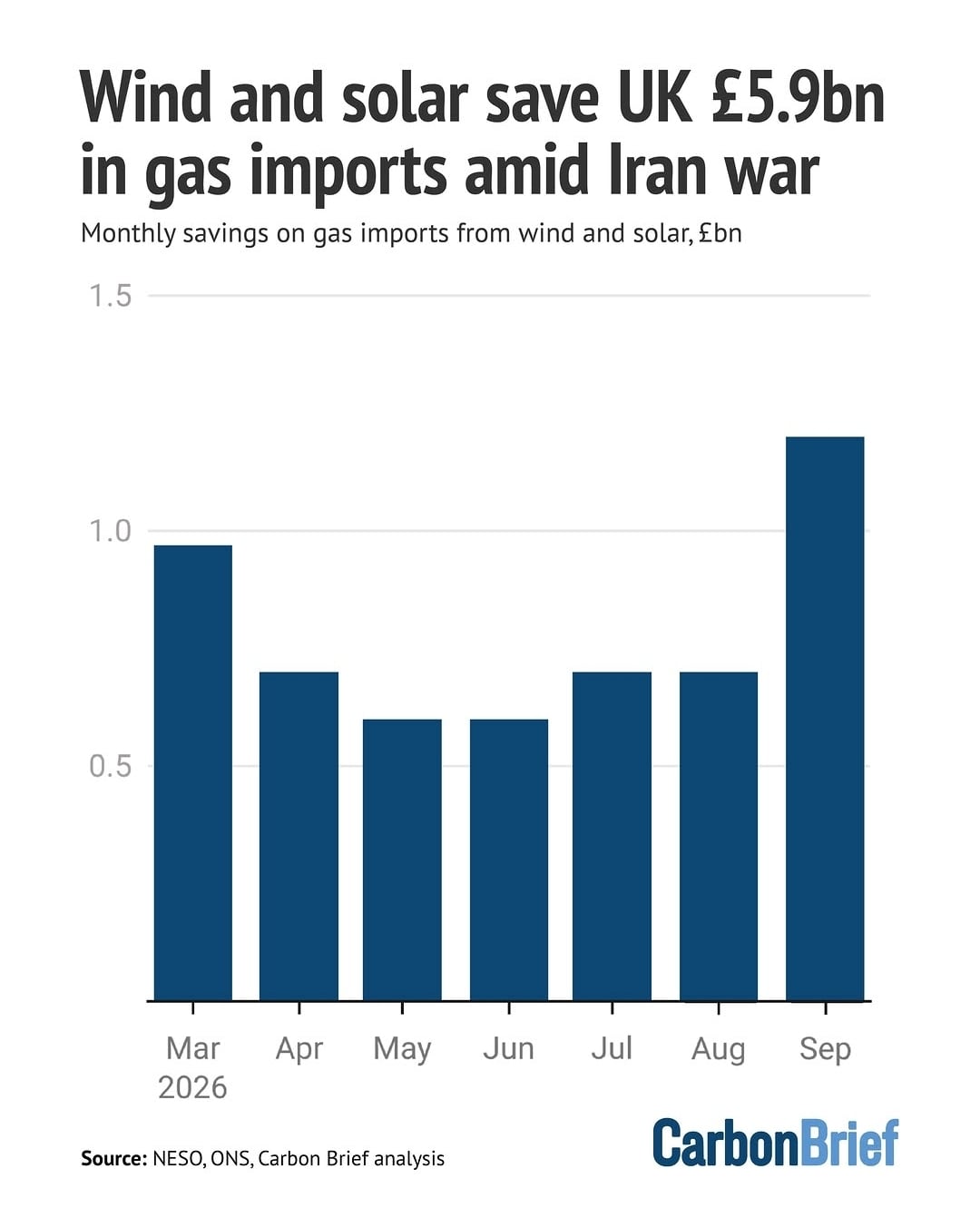
Latest ons data reveals massive savings for the UK from renewables amid the Iran war.
This both keeps prices lower than they otherwise would be under the marginal pricing system and is also excellent news for the economy as its a massive boost for the UK balance of payments and tax revenue.8 -
The forecasts have all generally said it "will reach it's peak", not "we have already reached it's peak".blackpool72 said:
It's gone up enormously decade on decade for the past 50 years.Siv_in_Shenzhen said:
See previous discussion about global population peaking and being about to begin to declineblackpool72 said:
Which is exactly why an ever increasing world population is the fucking problemME14addick said:
Fighting over scarce resources is extremely likely, as is migration, as more areas of the planet become unable to support growth of the food & supply the water that humans need to survive.cantersaddick said:
You've put it rather facetiously but wars and the military industrial complex are massive contributing factors to the climate crisis. Of course its all inextricably linked via our economic system.Starinnaddick said:My wife, who knows everything, told me the other day that the changeable weather is all caused by the high volume of rockets etc. in Ukraine and the Middle East.
Stopping facking fighting each other would go a long way to helping humanity save itself. Of course its more likely that humans will fight each other much more as the crisis bites.
I've heard plenty of forecasts saying it will reach It's peak and begin to decline but it's still rising.
Now hopefully one day the forecasts will prove to be correct but as things stand the population is still rising.
The UN forecasts that the peak will come in about 2090 but that assumes that the many countries with very low birth rates (eg S Korea, Japan, China, much of Europe) will rebound. But the UN seems consistently wrong in recent years, and has had to revise it's figures down. If you simply assume that current fertility trends continue, the peak will be 20-30 years earlier, and only that late because of falling death rates (i.e.people in.poorer countries don't die so quickly.)
Birth rates in countries like India have plunged, and there are no countries which have yet experienced significant rebounds in birth rates1 -
Still hoping Tropical Storm Dolly might do us all a favour in Florida 😉1